+86-13915203580

What Is Steel Alloy Made Of? Composition & Forging Guide

Home / News / Industry News / What Is Steel Alloy Made Of? Composition & Forging Guide

What Is Steel Alloy Made Of? Composition & Forging Guide

Content

Direct Answer

Steel alloy is fundamentally made of iron and carbon, but what transforms ordinary steel into high-performance alloy steel is the deliberate addition of one or more alloying elements — such as chromium, nickel, molybdenum, manganese, vanadium, or tungsten — each contributing specific mechanical or chemical properties. Alloy Steel forgings, produced by shaping this enriched material under high compressive forces, represent one of the most structurally reliable forms of metalworking in industrial manufacturing.

The base composition of steel is iron (Fe) typically combined with carbon (C) at levels ranging from 0.05% to 2.0% by weight. Alloying elements are then introduced in controlled percentages to modify hardness, tensile strength, corrosion resistance, toughness, or heat resistance depending on the application. This deliberate composition engineering is what separates alloy steel from plain carbon steel — and it is what makes Alloy Steel forgings so prized in demanding industries like oil and gas, aerospace, automotive, and heavy machinery.

The Core Elements That Make Up Alloy Steel

Understanding what alloy steel is made of requires looking at its elemental building blocks. Each element serves a purpose — none is added without a calculated reason.

Fe

Iron (Fe)

The primary base metal. Iron provides the structural backbone. Pure iron is relatively soft and ductile, which is why carbon and other alloying elements are added to increase its mechanical performance. Iron typically constitutes 97% or more of the total composition in most alloy steel grades.

C

Carbon (C)

The most critical alloying element. Carbon content directly controls hardness and tensile strength. Low-alloy steels contain carbon in the range of 0.15% to 0.50%. Higher carbon content increases hardness but reduces weldability and toughness, requiring a careful balance in forging applications.

Cr

Chromium (Cr)

Added in amounts from 0.5% to 18%, chromium dramatically improves corrosion resistance and hardness. At levels above 10.5%, steel becomes stainless. In Alloy Steel forgings for high-temperature applications, chromium also stabilizes carbides at elevated temperatures, preventing softening under heat.

Ni

Nickel (Ni)

Nickel improves toughness, particularly at low temperatures, and enhances corrosion resistance. It is commonly used in amounts of 1% to 5% in structural alloy steels. In combination with chromium, nickel creates some of the most impact-resistant alloy steels available for pressure vessel forgings and turbine components.

Mo

Molybdenum (Mo)

One of the most valued additions in high-performance alloy steels, molybdenum is typically added at 0.15% to 1.0%. It significantly enhances hardenability, resistance to temper embrittlement, and high-temperature strength. Alloy Steel forgings used in oil drilling and petrochemical environments almost always contain molybdenum.

Mn

Manganese (Mn)

Manganese contributes to deoxidation during steelmaking and improves hardenability and tensile strength. It neutralizes the harmful effects of sulfur by forming manganese sulfide instead of iron sulfide. Levels typically range from 0.30% to 1.80% in standard alloy steel grades.
How Alloy Steel Is Classified: Low-Alloy vs. High-Alloy

Not all alloy steels are equal in composition or performance. The industry divides them into two broad categories based on the total percentage of alloying elements present. This classification has a direct impact on forging parameters, heat treatment requirements, and end-use applications.

Classification of alloy steel by total alloying element content and typical applications
Category Total Alloy Content Common Alloying Elements Typical Applications
Low-Alloy Steel Less than 8% Cr, Mo, Ni, Mn, V Pressure vessels, pipelines, structural forgings, automotive components
High-Alloy Steel 8% or more Cr, Ni, Mo, W, Co Aerospace, gas turbines, chemical processing, high-temperature forgings
Stainless Steel (subset) Above 10.5% Cr minimum Cr, Ni, Mo Food processing, marine, medical, valve forgings
Tool Steel (subset) Variable, high C + alloys W, Mo, Cr, V Cutting tools, dies, molds, forging tooling

In the forging industry, low-alloy steels account for the majority of Alloy Steel forgings produced worldwide, primarily because they offer an excellent balance of mechanical properties and cost-efficiency. High-alloy grades are reserved for extreme service conditions where performance requirements justify the increased material cost.

How Alloy Steel Is Produced: From Raw Ore to Finished Composition

The production of alloy steel is a multi-stage metallurgical process requiring precise control at each step. Understanding this process explains why composition consistency matters so much in Alloy Steel forgings — even small deviations in chemistry can significantly affect the final properties of the forged part.

01

Iron Ore Smelting and Primary Steel Production

The process begins in a blast furnace where iron ore, coke, and limestone are combined at temperatures exceeding 1,500°C. This produces pig iron — a high-carbon, high-impurity form of iron. Pig iron is then refined in a basic oxygen furnace (BOF) or electric arc furnace (EAF) to reduce carbon content and remove unwanted impurities like sulfur and phosphorus, producing crude steel.

02

Secondary Metallurgy and Alloying Element Addition

Alloying elements are added during secondary metallurgy, often in a ladle furnace. Ferro-alloys (iron-chromium, ferro-molybdenum, ferro-vanadium, etc.) are introduced in precise quantities to achieve the target chemistry. Vacuum degassing may be employed to minimize hydrogen and oxygen levels — especially critical for Alloy Steel forgings that will be subjected to high stress environments. The entire ladle is stirred and sampled multiple times to confirm chemical homogeneity before casting.

03

Continuous Casting or Ingot Casting

The liquid alloy steel is solidified into billets, blooms, slabs, or ingots depending on the downstream forging process. For large Alloy Steel forgings — such as ring forgings, shafts, or pressure vessel bodies — ingot casting is often preferred. Ingots may weigh anywhere from a few hundred kilograms to over 300 metric tons. Solidification rate and ingot geometry affect the internal soundness of the material, which is why ingot design is part of the quality engineering process.

04

Homogenization and Conditioning

Cast ingots or billets are soaked in homogenization furnaces at temperatures typically between 1,100°C and 1,250°C for extended periods (up to 48 hours for large ingots) to eliminate segregation — the uneven distribution of alloying elements that occurs during solidification. This step is non-negotiable for premium Alloy Steel forgings where uniform properties throughout the cross-section are required.

What Makes Alloy Steel Forgings Different from Castings or Bar Stock

Once alloy steel is produced in its ingot or billet form, the material undergoes forging — a thermomechanical process that fundamentally changes the internal structure of the steel and elevates its mechanical properties far beyond what casting or machining from bar stock can achieve.

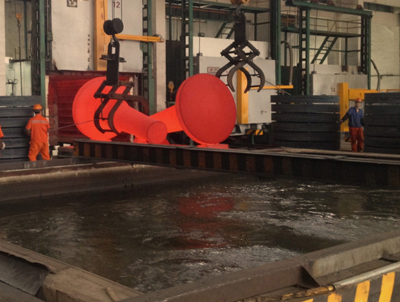
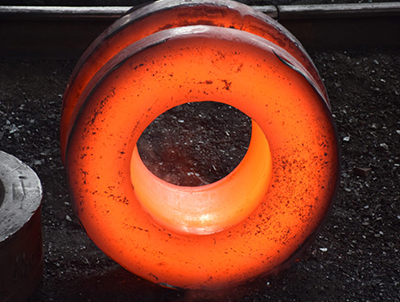
During the forging process, the alloy steel is heated to its forging temperature range — typically between 1,050°C and 1,250°C — and then shaped through compressive force using hydraulic presses, hammers, or ring rolling equipment. This deformation process achieves several critical outcomes:

  • Internal porosity and shrinkage cavities from casting are closed and consolidated, creating a fully dense, sound material.
  • The grain structure is refined and aligned along the shape of the part, creating a directional fiber structure that improves strength in the primary stress direction.
  • Inclusions and segregation bands are broken up and redistributed, reducing their negative impact on fatigue life.
  • The thermomechanical work introduces controlled dislocation density in the crystal lattice, which contributes to higher yield strength.

The result is that Alloy Steel forgings typically exhibit 20% to 40% higher fatigue strength compared to equivalent alloy steel castings with the same composition. This is why safety-critical components — turbine discs, landing gear, pressure flanges, drill collars — are almost always specified as forgings rather than castings.

Common Alloy Steel Grades Used in Forgings and What They Contain

The global steel industry has standardized hundreds of alloy steel grades, each with a defined composition range optimized for specific performance characteristics. The following grades are among the most widely used in Alloy Steel forgings:

4140

AISI 4140 — Chromium-Molybdenum Steel

Composition: 0.38–0.43% C, 0.80–1.10% Cr, 0.15–0.25% Mo, 0.75–1.00% Mn. One of the most widely used alloy steels globally. Offers excellent hardenability, fatigue resistance, and toughness. Commonly forged into shafts, gears, axles, connecting rods, and tool joints for the oil and gas sector. Tensile strength after heat treatment reaches 950–1,100 MPa depending on section thickness and tempering temperature.

4340

AISI 4340 — Nickel-Chromium-Molybdenum Steel

Composition: 0.38–0.43% C, 0.70–0.90% Cr, 0.20–0.30% Mo, 1.65–2.00% Ni. Known as an aircraft-quality alloy steel, 4340 provides outstanding strength and toughness even in large cross-sections. Alloy Steel forgings made from 4340 are used in aircraft undercarriages, crankshafts, and armor-grade structural components. Tensile strength can exceed 1,400 MPa when appropriately heat treated.

F22

ASTM A182 F22 — Chromium-Molybdenum Alloy (2.25Cr-1Mo)

A high-temperature service alloy containing 2.00–2.50% Cr and 0.87–1.13% Mo. Widely specified for pressure vessel and piping forgings in petrochemical and refinery environments. This grade maintains strength and resists hydrogen attack at temperatures up to 550°C, making it indispensable in hydroprocessing equipment flanges, valve bodies, and reactor nozzles.

P91

Grade P91 — Modified 9Cr-1Mo Steel

Composition: 8.00–9.50% Cr, 0.85–1.05% Mo, 0.18–0.25% V, 0.06–0.10% Nb. Developed specifically for high-pressure, high-temperature steam service in power generation. Alloy Steel forgings from P91 are used in main steam piping, headers, and valve bodies operating at temperatures up to 620°C. The addition of vanadium and niobium creates fine carbide precipitates that resist creep deformation over decades of service.

Heat Treatment of Alloy Steel Forgings: Unlocking the True Properties

The composition of alloy steel defines its potential, but heat treatment is what unlocks and tailors that potential for a specific application. Alloy Steel forgings almost always undergo at least one heat treatment operation after forging, and many undergo multiple sequential treatments.

Normalizing

The forging is heated to a temperature approximately 50°C to 70°C above the upper critical temperature (Ac3) and then air-cooled. Normalizing refines the grain structure disturbed during forging and relieves residual stresses. For alloy steels, normalizing temperatures typically fall between 860°C and 950°C. This treatment is frequently the first step before quenching and tempering.

Quenching and Tempering (Q&T)

Quenching involves heating the forging to the austenitizing temperature (typically 830°C to 900°C for most Cr-Mo alloy steels) and rapidly cooling it in water, oil, or polymer quench media. This produces a martensitic microstructure with very high hardness — often above 50 HRC — but also high brittleness. Tempering then heats the martensitic forging to a lower temperature, usually between 540°C and 700°C, to reduce brittleness while retaining the majority of the strength improvement. The final mechanical properties are highly controllable through tempering temperature selection.

Annealing

Used when the forging needs maximum softness for machining, or when internal stresses need to be fully removed. Full annealing involves slow furnace cooling from above Ac3, producing a predominantly ferritic-pearlitic microstructure. For some complex Alloy Steel forgings with intricate machining requirements, annealing reduces tool wear and machining cycle times significantly — sometimes cutting machining time by 30% to 50% compared to forging in the as-quenched condition.

Post-Weld Heat Treatment (PWHT)

Many Alloy Steel forgings are incorporated into welded assemblies. After welding, the heat-affected zone (HAZ) contains a hardened, brittle microstructure and residual tensile stresses that can lead to delayed cracking or service failure. PWHT at temperatures typically between 600°C and 760°C for Cr-Mo alloy steels tempers the HAZ, reduces hydrogen content, and lowers residual stresses to acceptable levels. For pressure vessel forgings, PWHT is a mandatory requirement under most design codes.

Industries That Depend on Alloy Steel Forgings and Why Composition Matters

The selection of alloy steel composition for forgings is always application-driven. Different industries place very different demands on their forged components, and the alloying strategy must be matched precisely to the service environment.

OG

Oil and Gas Industry

Drill collars, valves, wellhead equipment, and pipeline flanges operate in environments with extreme pressure, H2S-induced stress corrosion, and corrosive fluids. Alloy Steel forgings in this sector commonly use AISI 4130, 4140, and F22 grades, all of which combine adequate corrosion resistance with the high yield strength needed to withstand pressures above 100 MPa in deep-well applications.

AE

Aerospace and Defense

Landing gear components, actuator rods, and structural attachment fittings require the highest strength-to-weight ratios achievable in steel. AISI 4340 and its vacuum-arc-remelted (VAR) variants provide tensile strengths up to 1,800 MPa at fracture toughness levels compatible with damage-tolerant design. Every gram of weight saved in an aircraft has long-term operational value, which is why the alloy composition in aerospace Alloy Steel forgings is controlled to tolerances far tighter than standard commercial grades.

PW

Power Generation

Steam turbine rotors, generator shafts, and pressure vessel nozzles in nuclear and thermal power plants operate continuously at high temperature and pressure for decades. Alloy Steel forgings in this sector use creep-resistant grades like P91, P92, and 12Cr-1Mo, where vanadium, niobium, and tungsten additions create microstructural stability that prevents dimensional change and strength loss over 100,000+ hours of service at temperatures above 550°C.

AU

Automotive and Heavy Machinery

Crankshafts, camshafts, connecting rods, axle shafts, and gearbox components represent the largest volume segment of the global Alloy Steel forgings market. Grades like 5140 (Cr steel) and 8620 (Ni-Cr-Mo carburizing steel) dominate here, offering a combination of surface hardness from case hardening and tough core properties from the alloy composition. Annual production of automotive alloy steel forgings exceeds 10 million metric tons globally, making automotive the single largest end-use segment.

Testing and Quality Verification of Alloy Steel Forgings

Because the composition of alloy steel directly determines the properties of the final forging, rigorous testing at multiple stages of production is standard practice. The following tests are routinely performed on Alloy Steel forgings to verify that the material meets specification requirements:

Chemical Analysis

Optical emission spectrometry (OES) or X-ray fluorescence (XRF) is used to verify the chemical composition of every heat of alloy steel before forging. Results must fall within the specified composition range for each element. For critical applications, ladle analysis is supplemented by product analysis taken from the finished forging.

Mechanical Testing

Tensile testing (per ASTM E8 or ISO 6892) measures yield strength, ultimate tensile strength, elongation, and reduction in area. Charpy impact testing (per ASTM E23) evaluates toughness at specified temperatures. Hardness testing (Brinell, Rockwell, or Vickers) verifies heat treatment response across the forging cross-section.

Ultrasonic Testing (UT)

Automated or manual UT is used to detect internal discontinuities such as porosity, cracks, or inclusions within the body of the forging. Acceptance criteria are defined by standards such as ASTM A388 or EN 10228-3. For large Alloy Steel forgings used in pressure vessels or turbines, UT is performed at 100% of the forging volume.

Magnetic Particle Testing (MT)

MT detects surface and near-surface discontinuities in ferritic alloy steels. The forging is magnetized and fine ferromagnetic particles reveal crack indications at the surface. This test is particularly important for Alloy Steel forgings that have been machined, since machining can reveal subsurface cracks or expose seams that were not visible in the rough-forged condition.

Alloy Steel vs. Plain Carbon Steel in Forging Applications

A practical question in any forging design process is whether the additional cost of alloying elements is justified compared to plain carbon steel. The following comparison provides a data-driven perspective:

Key property comparison between plain carbon steel and common alloy steel forging grades
Property Plain Carbon Steel (1045) Alloy Steel (4140) Alloy Steel (4340)
Tensile Strength (Q&T) 570–700 MPa 950–1,100 MPa 1,200–1,450 MPa
Hardenability Low (shallow hardening) Medium-High Very High
Toughness at low temperature Poor Good Excellent
Corrosion resistance Poor Moderate Moderate
High-temperature strength Poor above 300°C Good to 450°C Good to 450°C
Relative Material Cost Lowest 1.5–2x plain carbon 2.5–4x plain carbon

In applications where the forging is small, lightly loaded, or easily replaceable, plain carbon steel may be a practical choice. However, for any component where failure would be catastrophic, or where reducing section size (weight) is commercially important, Alloy Steel forgings deliver a cost-performance advantage that quickly offsets the higher material price through reduced component weight, extended service life, and lower maintenance frequency.

How to Select the Right Alloy Steel Grade for Your Forging Requirement

Selecting the correct alloy steel composition for a forging project is a structured engineering decision. The following factors should be evaluated systematically:

  1. Service temperature range: For ambient and moderate temperatures up to 400°C, standard Cr-Mo grades like 4140 or F11 are sufficient. For temperatures above 500°C, modified 9Cr grades (P91, P92) or austenitic stainless forgings should be considered.
  2. Required strength level: Determine the minimum yield strength and tensile strength required by the design. For yield strengths above 900 MPa, nickel-containing grades (4340, 300M) or ultra-high-strength alloy steels should be selected.
  3. Section thickness and hardenability: Larger section forgings require higher hardenability to achieve through-hardening. Plain alloy steels like 4140 can be fully hardened in sections up to approximately 75mm diameter; for larger sections, higher-nickel grades or vacuum-remelted variants are needed.
  4. Corrosive environment: If the forging will be exposed to H2S, chlorides, or acid environments, corrosion-resistant alloy steels with higher chromium or stainless grades should be considered, even if the base mechanical requirements could be met by a simpler alloy.
  5. Weldability requirements: Higher carbon and alloy content generally reduces weldability. If the Alloy Steel forging will be welded in service, a carbon equivalent (CE) value below 0.45 is typically targeted to avoid hydrogen-induced cracking in the HAZ without mandatory preheating.
  6. Impact toughness at low temperatures: For offshore, Arctic, or cryogenic applications, Charpy impact energy at the minimum design temperature must be specified. Nickel additions are the most effective way to maintain toughness at sub-zero temperatures in alloy steel forgings.

Emerging Trends in Alloy Steel Composition and Forging Technology

The field of alloy steel development is not static. Research and industrial development efforts continue to push the boundaries of what alloy steel compositions can achieve, with significant implications for next-generation Alloy Steel forgings.

Advanced High-Strength Low-Alloy (AHSLA) Steels

These grades achieve tensile strengths above 1,000 MPa with total alloy content below 3%, primarily through microalloying additions of niobium (0.02–0.06%), titanium (0.01–0.04%), and vanadium (0.05–0.15%). The mechanism relies on precipitation hardening from fine carbide and nitride particles that form during controlled cooling after forging. The result is a grade that combines the strength of traditional high-alloy steel with significantly improved weldability and a lower raw material cost.

Thermomechanical Controlled Processing (TMCP) for Forgings

TMCP integrates forging deformation with controlled cooling in a single coordinated sequence, replacing conventional reheating and quenching cycles. For alloy steels, TMCP can achieve grain sizes below 10 micrometers — far finer than conventionally forged and heat-treated material. The finer grain size simultaneously improves strength, toughness, and fatigue resistance without increasing the alloy content, reducing heat treatment energy consumption by up to 25% in some forging operations.

Additive Manufacturing as a Complement to Forgings

While additive manufacturing (AM) cannot replicate the fiber structure and density of Alloy Steel forgings, it is increasingly being used for near-net-shape preforms that are subsequently forged. This hybrid approach reduces material waste from 60–70% buy-to-fly ratios typical in conventional forging to below 30% for complex shapes, while preserving the structural integrity benefits of the forging process. Alloy steel powders for AM are a growing specialty segment, with compositions closely mirroring established wrought alloy grades.

Computational Alloy Design

CALPHAD-based computational thermodynamics tools now allow metallurgists to design new alloy steel compositions by predicting phase diagrams, transformation temperatures, and microstructural evolution before a single kilogram of steel is melted. This approach is dramatically accelerating the development cycle for new Alloy Steel forging grades — reducing the time from concept to qualified production grade from the traditional 10–15 years to as little as 3–5 years in some programs.

Contact us now