

 英语
英语 德语
德语 阿拉伯语
阿拉伯语

Content
- 1 How Strong Is Carbon Steel — The Direct Answer
- 2 Carbon Content and Its Direct Effect on Strength
- 3 How Steel Forging Dramatically Increases Strength
- 4 Common Carbon Steel Grades and Their Strength Ratings
- 5 Heat Treatment: The Fastest Way to Boost Carbon Steel Strength
- 6 Carbon Steel vs. Stainless Steel vs. Alloy Steel: A Strength Comparison
- 7 The Role of Microstructure in Carbon Steel Strength
- 8 Applications Where Carbon Steel Strength Is Critical
- 9 Factors That Reduce Carbon Steel Strength in Service
- 10 Choosing the Right Carbon Steel Grade and Process for Your Application
How Strong Is Carbon Steel — The Direct Answer
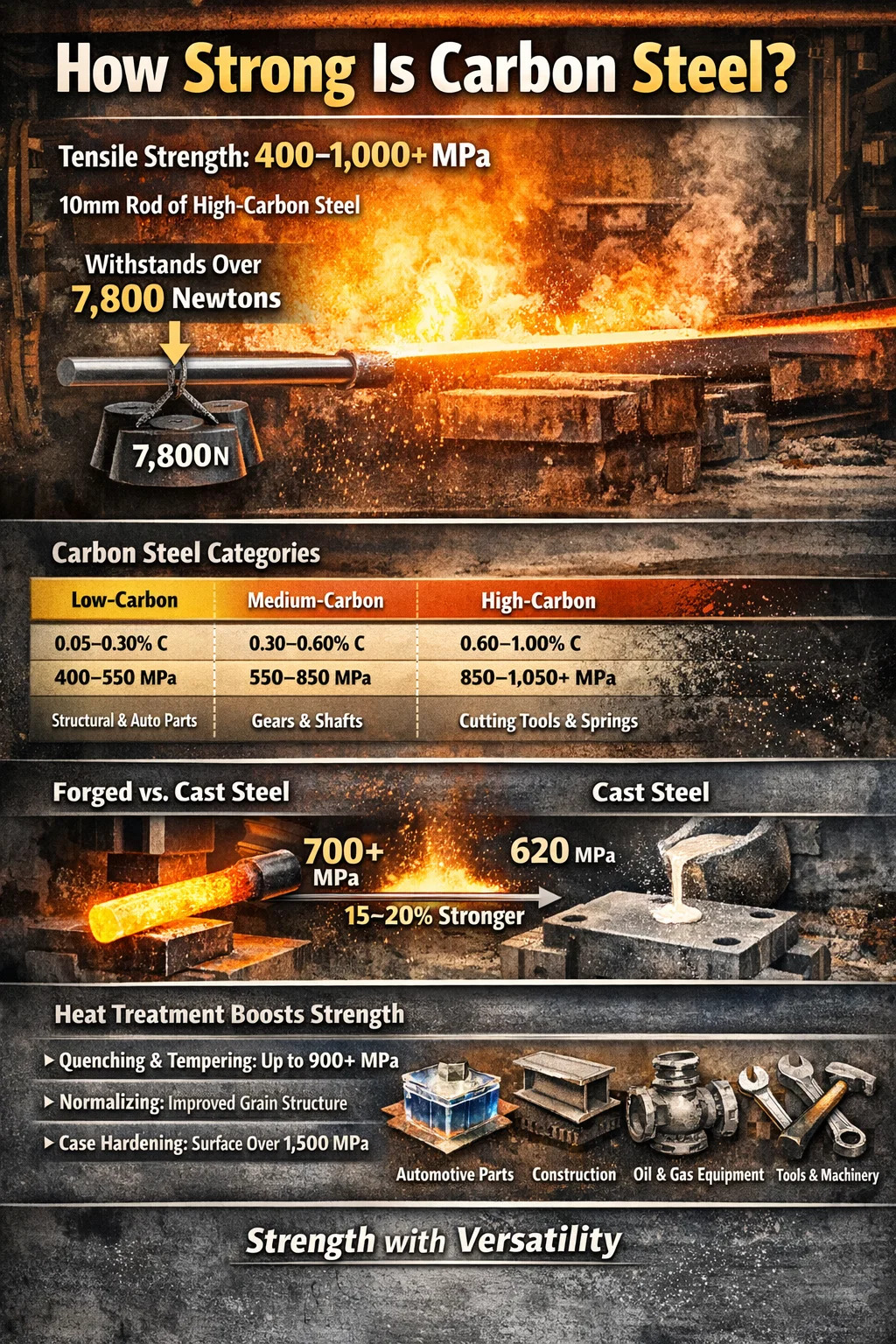
Carbon steel is one of the strongest and most widely used engineering materials in the world. Its tensile strength typically ranges from 400 MPa for low-carbon grades up to 1,000 MPa or more for high-carbon and heat-treated variants. To put that in perspective, a 10mm diameter rod of high-carbon steel can withstand a tensile load exceeding 7,800 newtons before failure. That kind of performance, combined with relatively low cost, is why carbon steel dominates construction, automotive, tooling, and heavy machinery applications globally.
The strength of carbon steel is not a fixed number — it varies significantly based on carbon content, alloying elements, heat treatment, and manufacturing process. A component produced through steel forging, for example, will consistently outperform an equivalent part made by casting or machining from bar stock, even if the base material grade is identical. Understanding these variables is the key to selecting and using carbon steel effectively.
Carbon Content and Its Direct Effect on Strength
Carbon is the primary strengthening element in carbon steel. As carbon content increases, hardness and tensile strength rise — but so does brittleness and reduced weldability. The relationship is not perfectly linear, but the general trend is consistent and well-documented across decades of metallurgical research.
Carbon steel is broadly divided into three categories based on carbon percentage:
- Low-carbon steel (0.05%–0.30% C): Tensile strength typically 400–550 MPa. Highly ductile and weldable. Common in structural beams, sheet metal, pipes, and automotive body panels.
- Medium-carbon steel (0.30%–0.60% C): Tensile strength typically 550–850 MPa. Good balance of strength and toughness. Widely used in shafts, gears, railway tracks, and forgings.
- High-carbon steel (0.60%–1.00% C): Tensile strength typically 850–1,000+ MPa. Extremely hard but more brittle. Used in cutting tools, springs, wire ropes, and wear-resistant components.
Beyond 1.00% carbon, the material enters the ultra-high-carbon or cast iron territory, where brittleness becomes a serious engineering concern. Most practical carbon steel applications sit below this threshold.
| Category | Carbon Content | Typical Tensile Strength | Typical Yield Strength | Common Uses |
|---|---|---|---|---|
| Low-Carbon | 0.05%–0.30% | 400–550 MPa | 250–350 MPa | Structural steel, pipes, auto panels |
| Medium-Carbon | 0.30%–0.60% | 550–850 MPa | 350–580 MPa | Gears, shafts, forgings, rails |
| High-Carbon | 0.60%–1.00% | 850–1,050 MPa | 580–900 MPa | Springs, cutting tools, wire rope |
How Steel Forging Dramatically Increases Strength
Among all manufacturing processes, steel forging stands out as the most reliable method for maximizing the mechanical strength of carbon steel. The forging process involves shaping heated steel under high compressive force — either through drop forging, press forging, or roll forging — which fundamentally alters the internal grain structure of the material in a beneficial way.
When carbon steel is cast, the cooling process produces a random, often dendritic grain structure with potential porosity and segregation. In contrast, steel forging refines and aligns the grain flow to match the geometry of the finished part. This directional grain structure is what makes forged components significantly tougher and more fatigue-resistant than cast equivalents.
Strength Gains from Forging: Measured Data
Studies comparing forged versus cast carbon steel components consistently show measurable improvements across multiple mechanical properties. For AISI 1045 medium-carbon steel (a standard forging grade), the differences are well documented:
- Tensile strength: cast ~620 MPa vs. forged ~700–750 MPa (approximately 15–20% higher)
- Yield strength: cast ~415 MPa vs. forged ~485–530 MPa
- Impact toughness (Charpy): forged parts can exhibit up to 37% better impact resistance
- Fatigue life: forged components routinely demonstrate 2–3x longer service life under cyclic loading conditions
These advantages make steel forging the preferred manufacturing route for safety-critical components including crankshafts, connecting rods, axles, flanges, valve bodies, and structural fasteners. Any application where failure would have serious consequences almost always specifies forged carbon steel over cast alternatives.
Forging Temperature and Its Effect on Final Properties
The temperature at which steel forging is performed also influences the final mechanical properties. Hot forging (typically 1,100–1,250°C for carbon steel) allows extensive deformation with minimal force and produces a refined grain structure. Warm forging (700–900°C) offers tighter dimensional tolerances and better surface finish while still providing meaningful grain refinement. Cold forging (room temperature or slightly above) produces the highest surface hardness and dimensional accuracy but is generally limited to smaller sections due to the high forces involved.
For high-strength applications, hot forging followed by controlled cooling or heat treatment is the most common approach. A forged AISI 4140 steel crankshaft, for example, after quench and temper heat treatment, can achieve tensile strengths exceeding 1,000 MPa with yield strength above 850 MPa — performance levels that would be difficult to reliably achieve through casting alone.
Common Carbon Steel Grades and Their Strength Ratings
Different grades of carbon steel are engineered for different performance profiles. Knowing the strength ratings of specific grades is essential when specifying materials for engineering projects or evaluating existing designs.
AISI 1018 — Low-Carbon Workhorse
AISI 1018 contains approximately 0.18% carbon and is one of the most commonly used low-carbon grades. In the as-rolled condition, it has a tensile strength of around 440 MPa and yield strength of 370 MPa. Its elongation at break is typically 15%, indicating good ductility. It machines and welds easily, making it the default choice for general structural work, shafts, and pins that do not require extreme strength.
AISI 1045 — Medium-Carbon Forging Grade
With 0.43–0.50% carbon, AISI 1045 is one of the most popular medium-carbon grades for steel forging applications. Normalized, it delivers tensile strength of approximately 585 MPa. After quench and temper heat treatment, this rises to 700–800 MPa depending on section size and tempering temperature. AISI 1045 is the standard material for automotive shafts, couplings, and machine tool parts that require a combination of strength and machinability.
AISI 1095 — High-Carbon Spring and Blade Steel
AISI 1095 sits near the top of the practical carbon range at 0.90–1.03% carbon. Hardened and tempered to a moderate hardness of around 48 HRC, it can achieve tensile strengths in the region of 1,860 MPa — a figure that places it among the strongest common steel grades available. However, its notch sensitivity and reduced toughness mean it is specifically suited to springs, cutting blades, and high-wear applications rather than general structural use.
ASTM A36 — Structural Carbon Steel
ASTM A36 is the most widely specified structural carbon steel in North America and is used extensively in building frames, bridges, and infrastructure. Its minimum tensile strength is 400 MPa (58 ksi), with a minimum yield of 250 MPa (36 ksi). It is not designed for extreme strength but for reliable, consistent performance in large-scale structural applications where weldability and cost are primary concerns.
| Grade | Carbon % | Tensile Strength (MPa) | Yield Strength (MPa) | Hardness (HB) |
|---|---|---|---|---|
| ASTM A36 | ≤0.29% | 400–550 | 250 min | ~119–162 |
| AISI 1018 | 0.15–0.20% | 440 | 370 | ~126 |
| AISI 1045 | 0.43–0.50% | 585 (normalized) | 450 | ~170 |
| AISI 1095 (hardened) | 0.90–1.03% | 1,860 | 1,650 | ~534 |
Heat Treatment: The Fastest Way to Boost Carbon Steel Strength
Heat treatment is arguably the most powerful tool available for manipulating the strength of carbon steel. The same grade of steel can have dramatically different mechanical properties depending on the thermal process it has undergone. For medium and high-carbon grades, the difference between annealed and fully hardened conditions can amount to a doubling of tensile strength.
Quenching and Tempering
Quench and temper (Q&T) is the most common heat treatment for high-strength carbon steel components. The steel is heated to its austenitizing temperature (typically 800–900°C for most carbon grades), held to achieve a uniform austenite microstructure, then rapidly cooled (quenched) in water, oil, or polymer solution. This rapid cooling produces a martensitic microstructure — extremely hard but brittle. The steel is then tempered at a lower temperature (150–650°C) to trade some hardness for improved toughness.
A practical example: AISI 1045 steel in the normalized condition has tensile strength around 585 MPa. After Q&T with a temper temperature of 315°C, this rises to approximately 900 MPa with yield strength around 765 MPa. Raising the temper temperature to 540°C reduces this to around 700 MPa tensile but significantly improves impact toughness — a trade-off that engineers choose deliberately based on service requirements.
Normalizing
Normalizing involves heating carbon steel above its critical temperature and then air cooling. It produces a more uniform and refined grain structure than the as-rolled or as-forged condition. For steel forging operations, normalizing is often specified as a post-forging treatment to relieve internal stresses and establish a consistent baseline microstructure before final machining or further heat treatment. Normalized steel typically has slightly higher strength than annealed steel but lower strength than Q&T steel.
Case Hardening
For low-carbon steel grades that do not respond strongly to through-hardening, surface hardening processes like carburizing, carbonitriding, or induction hardening are used. Carburizing introduces additional carbon into the surface layer (typically to depths of 0.5–2.0 mm), creating a hard, wear-resistant case with tensile strength at the surface potentially exceeding 1,500 MPa while the core retains its toughness. This combination is ideal for gears, camshafts, and bearing races.
Carbon Steel vs. Stainless Steel vs. Alloy Steel: A Strength Comparison
One of the most frequent questions in materials selection is how carbon steel compares in strength to stainless steel and alloy steel. The answer is more nuanced than a simple ranking because all three categories span a wide range of grades and conditions.
In general terms:
- Standard austenitic stainless steels (e.g., 304, 316) have tensile strengths in the range of 515–620 MPa in the annealed condition — comparable to medium-carbon steel but with much lower yield strength (around 207 MPa). They cannot be hardened by heat treatment to the same degree as carbon steel.
- Martensitic stainless steels (e.g., 440C) can be hardened to around 1,900 MPa tensile strength, rivaling high-carbon tool steels, but at much greater material cost.
- Alloy steels (e.g., AISI 4140, 4340) add chromium, molybdenum, or nickel to carbon steel to improve hardenability and toughness. A quenched and tempered AISI 4340 alloy steel shaft can reach tensile strengths exceeding 1,900 MPa while maintaining better toughness than an equivalent carbon grade at that strength level.
- Plain carbon steel in optimized grades and conditions can match or exceed standard stainless grades in strength while offering far superior machinability and lower cost. Where corrosion resistance is not needed, carbon steel is almost always the stronger value proposition.
For steel forging applications specifically, both plain carbon and alloy steel grades are regularly used. The choice between them depends on section size (thicker sections require higher hardenability — favoring alloy grades), service environment, and required toughness at operating temperature.
The Role of Microstructure in Carbon Steel Strength
Strength in carbon steel is ultimately a product of microstructure — the arrangement of phases, grain boundaries, and precipitates at the microscopic level. Understanding these microstructural features explains why the same grade of steel can behave very differently depending on how it was processed.
Ferrite and Pearlite
In the normalized or annealed condition, carbon steel consists primarily of ferrite (soft, ductile iron) and pearlite (a lamellar mix of ferrite and iron carbide). As carbon content increases, the proportion of pearlite increases, raising strength and hardness at the expense of ductility. A fully pearlitic 0.80% carbon steel (eutectoid composition) has higher strength than a ferrite-dominated 0.20% steel, but considerably less elongation.
Martensite
Martensite is the hardest microstructure achievable in carbon steel and is produced by rapid quenching. Its hardness is directly proportional to carbon content. For 0.60% carbon steel, full martensite hardness reaches approximately 65 HRC (Rockwell C) — an exceptionally hard surface that resists abrasion and deformation. However, as-quenched martensite is extremely brittle, which is why tempering is always required to restore usable toughness before a component enters service.
Grain Size
Grain size is another critical microstructural variable. According to the Hall-Petch relationship, smaller grain size results in higher yield strength. Thermomechanical processing during steel forging directly refines grain size. A forged and normalized component can have a grain size of ASTM 8 or finer, compared to ASTM 5–6 for an equivalent casting. This difference alone can add 50–100 MPa to yield strength without any change in composition.
Applications Where Carbon Steel Strength Is Critical
The strength of carbon steel makes it the backbone of numerous industries. The following applications illustrate how strength requirements drive material and process selection in practice.
Automotive Powertrain Components
Crankshafts, connecting rods, and transmission gears are among the most demanding applications for carbon and alloy steel forgings. A diesel engine crankshaft may be subjected to peak bending stresses exceeding 600 MPa at millions of cycles over its service life. The forged grain flow, combined with surface treatments like fillet rolling or nitriding, extends fatigue life to the point where the component outlasts the rest of the engine. AISI 1045 and microalloyed variants are standard forging grades for this application.
Construction and Structural Engineering
High-strength structural carbon steel grades like ASTM A572 Grade 50 (minimum yield 345 MPa, tensile 450 MPa) and A514 (minimum yield 690 MPa) allow engineers to reduce section sizes and overall structure weight without compromising load capacity. The savings in material volume can be substantial — a bridge girder designed in A514 steel may use 40–50% less steel by weight compared to an equivalent A36 design.
Oil and Gas Pressure Equipment
Forged carbon steel valves, flanges, and fittings used in high-pressure pipelines must meet strict ASME and ASTM standards. ASTM A105 carbon steel forgings for piping components specify a minimum tensile strength of 485 MPa and yield of 250 MPa, with proof pressure testing required before installation. High-pressure gate valves in gas transmission service can operate at pressures exceeding 700 bar — conditions that demand the reliability only a forged microstructure can consistently provide.
Hand Tools and Agricultural Equipment
Drop-forged hand tools — wrenches, hammers, pliers — are a familiar everyday application of carbon steel forging strength. A drop-forged wrench in AISI 1045 can withstand impact loads and overtorque events that would crack a cast equivalent. Agricultural tillage tools subjected to repeated ground impact are similarly specified in forged medium to high-carbon grades, often with heat treatment to achieve edge hardness exceeding 50 HRC while maintaining a tough core.
Factors That Reduce Carbon Steel Strength in Service
Understanding what makes carbon steel strong must also include understanding what degrades that strength in real-world conditions. Engineers must account for these factors during design to ensure safe long-term performance.
- Elevated temperature: Carbon steel loses strength progressively above approximately 300°C. At 500°C, yield strength can drop to 50% of the room-temperature value. High-temperature applications require either alloy steel grades or refractory alloys.
- Corrosion: Carbon steel corrodes readily in the presence of moisture and oxygen. Pitting and section loss from corrosion can reduce effective cross-section and create stress concentration points that dramatically reduce fatigue strength. Proper surface protection is essential in outdoor or humid environments.
- Hydrogen embrittlement: High-strength carbon steel components (tensile strength above ~1,000 MPa) are susceptible to hydrogen embrittlement, particularly during electroplating, acid pickling, or in hydrogen-rich environments. Affected parts can fail at stresses well below their rated yield strength with little warning.
- Stress concentrations: Notches, sharp corners, surface defects, and weld toes act as stress raisers that amplify local stresses. In fatigue loading, a stress concentration factor of 2 or 3 effectively halves or thirds the usable fatigue strength of the component. Forged components have an advantage here because the forging process can produce smooth, continuous fiber flow that minimizes internal stress concentrations.
- Strain aging: Low-carbon steel that has been cold worked can experience strain aging — a time-dependent increase in hardness and strength accompanied by a reduction in toughness, particularly at low temperatures. This is a concern in structures operating in arctic or sub-zero environments.
Choosing the Right Carbon Steel Grade and Process for Your Application
Selecting carbon steel for a structural or mechanical application is not simply a matter of choosing the highest-carbon grade available. The correct choice depends on a clear understanding of service loads, environmental conditions, manufacturing constraints, and cost targets. The following framework covers the most common decision points.
Define the Required Strength Level First
Start with the stress analysis. Calculate the maximum tensile, compressive, shear, and fatigue stresses the component will experience in service, including any dynamic or impact loads. Apply appropriate safety factors — typically 1.5 to 3.0 depending on application criticality. This gives a target yield strength that the selected material and process combination must meet or exceed.
Match Manufacturing Process to Strength Requirements
If the required strength can be achieved with low-carbon steel and no heat treatment, welded fabrication from hot-rolled plate or tube is almost always the most economical solution. If yield strengths above 500 MPa are needed, or if the component has a complex geometry that must support high fatigue loads, steel forging becomes the preferred route. For components requiring extreme wear resistance at the surface with toughness in the core, case hardening of a forged low-carbon part is the standard approach.
Consider Section Size and Hardenability
Plain carbon steel has limited hardenability — the ability to develop full martensitic hardness at depth. For sections thicker than approximately 25–50 mm, the core of a quenched carbon steel part may not harden fully, resulting in lower strength at the center than at the surface. For thick-section forgings, alloy steel grades like 4140 or 4340 are specified precisely because their chromium and molybdenum content extends hardenability to much larger section sizes, ensuring uniform through-thickness strength.
Account for Total Cost of Ownership, Not Just Material Cost
A forged high-carbon steel component costs more to produce than a cast low-carbon equivalent. However, if the forged part has a service life three times longer, or if a premature failure in a cast part results in equipment downtime or safety incidents, the economics strongly favor forging. In industries like oil and gas, aerospace, and automotive, the cost of a failure event is orders of magnitude larger than any material or manufacturing cost saving. This is why steel forging dominates safety-critical applications despite its higher upfront cost.