

 英语
英语 德语
德语 阿拉伯语
阿拉伯语

Content
- 1 What Case Hardening Actually Does to Steel
- 2 The Main Methods Used to Case Harden Steel
- 3 Step-by-Step Process for Carburizing Steel at Home or in a Shop
- 4 Comparing Case Hardening Methods: A Practical Overview
- 5 Steel Grades Best Suited for Case Hardening
- 6 How Case Hardening Interacts with the Steel Forging Process
- 7 Controlling Case Depth and Hardness Consistency
- 8 Common Mistakes in Case Hardening and How to Avoid Them
- 9 Applications Where Case Hardened Steel Forging Components Are Standard
What Case Hardening Actually Does to Steel
Case hardening is a heat treatment process that hardens the outer surface of a steel part while keeping the inner core tough and ductile. The result is a component that resists wear and surface fatigue on the outside, but can absorb shock and stress without cracking on the inside. This combination is exactly what steel forging and machined components require in demanding applications like gears, camshafts, axles, and cutting tools.
The hardened outer layer — called the "case" — typically ranges from 0.1 mm to over 3 mm in depth, depending on the method used and the exposure time. The core remains relatively soft, usually between 20–40 HRC, while the case can reach 58–65 HRC in well-controlled processes. This dual-zone structure is not achievable through through-hardening alone, making case hardening a distinct and highly practical technique in steel forging and manufacturing.
It is worth understanding that not all steels respond equally to case hardening. Low-carbon steels (0.1%–0.3% carbon) are the most commonly case hardened because their cores remain ductile after treatment. Medium-carbon steels can also be treated, but high-carbon steels are generally through-hardened instead, since their cores are already capable of achieving high hardness.
The Main Methods Used to Case Harden Steel
There are several established methods for case hardening steel, each suited to different materials, case depth requirements, and production environments. Choosing the right one depends on the base steel alloy, the desired surface hardness, dimensional tolerances, and available equipment.
Carburizing
Carburizing is the most widely used case hardening method for steel forging components. The process involves exposing low-carbon steel to a carbon-rich environment at high temperatures — typically 850°C to 950°C (1560°F to 1740°F) — long enough for carbon to diffuse into the surface. Once sufficient carbon has been absorbed, the part is quenched to lock in the hardened case.
There are three common variants of carburizing:
- Gas carburizing: The part is placed in a furnace with a carbon-bearing gas atmosphere, usually endothermic gas enriched with natural gas or propane. This is the most controllable and scalable method, widely used in automotive and steel forging industries.
- Pack carburizing: The steel part is packed in a container with solid carbonaceous material (like charcoal mixed with barium carbonate) and heated for several hours. This is a low-tech method still used in small workshops or for irregular shapes.
- Liquid (salt bath) carburizing: The part is immersed in a molten cyanide-based salt bath. It is fast and effective but involves hazardous chemicals, so it has declined in usage due to environmental and safety concerns.
A typical gas carburizing cycle for achieving a 1 mm case depth on a low-carbon steel like AISI 8620 takes roughly 8–10 hours at 930°C. After carburizing, the part is quenched in oil or water, then tempered at 150°C–200°C to relieve quench stresses while retaining surface hardness above 60 HRC.
Nitriding
Nitriding introduces nitrogen into the steel surface rather than carbon. It operates at significantly lower temperatures — 480°C to 590°C (900°F to 1095°F) — which means distortion is minimal and no quenching is required. This makes nitriding particularly suitable for precision components and finished parts where dimensional accuracy is critical.
The resulting case is shallower than carburizing (typically 0.1 mm to 0.6 mm), but surface hardness values can exceed 70 HRC equivalent (1100 HV) in alloy steels containing nitride-forming elements like chromium, molybdenum, aluminum, and vanadium. Common nitriding grades include AISI 4140, 4340, and nitralloy steels.
Gas nitriding uses dissociated ammonia in a furnace. Plasma (ion) nitriding uses an electrical glow discharge to introduce nitrogen and can treat complex geometries more uniformly. Salt bath nitriding (ferritic nitrocarburizing) is faster and improves both wear resistance and corrosion resistance.
Induction Hardening
Induction hardening does not involve chemical diffusion. Instead, it uses electromagnetic induction to rapidly heat the surface of a steel part to above its austenitizing temperature, followed by immediate quenching. The process is extremely fast — surface heating can occur in 1 to 10 seconds — and produces a hard martensitic case without affecting the core.
This method requires medium-carbon steels (0.35%–0.55% carbon) or alloy steels that already have sufficient carbon to form martensite upon quenching. It is commonly used for shafts, gears, crankshafts, and rail components in the steel forging and automotive sectors. Case depths typically range from 1 mm to 6 mm depending on the frequency used and the heating time.
Higher induction frequencies produce shallower cases; lower frequencies penetrate deeper. A 10 kHz frequency might achieve a 3–5 mm case, while a 200 kHz frequency may only reach 0.5–1 mm. Hardness typically reaches 55–62 HRC on properly selected steels.
Flame Hardening
Flame hardening uses a direct oxy-acetylene or oxy-propane flame to heat the steel surface rapidly, followed by water quenching. It is one of the oldest selective surface hardening methods and requires no specialized furnace equipment. The technique works on medium-carbon and alloy steels and is frequently applied to large or unwieldy parts — such as large forgings, machine ways, and sprockets — that cannot easily fit inside furnaces or induction coils.
Case depths with flame hardening range widely from 1.5 mm to 6 mm, and hardness values of 50–60 HRC are achievable. However, the process is less controllable than induction hardening, and achieving consistent case depth across complex shapes requires skilled operators.
Cyaniding and Carbonitriding
Carbonitriding simultaneously introduces both carbon and nitrogen into the steel surface at temperatures of 700°C to 900°C. It is often considered a hybrid of carburizing and nitriding. The presence of nitrogen lowers the required quench severity, reduces distortion, and improves hardenability. Case depths are generally shallower than full carburizing — 0.07 mm to 0.75 mm — and it is widely used for thin-section parts, fasteners, and small gears.
Cyaniding uses a liquid sodium cyanide bath to introduce carbon and nitrogen simultaneously. While effective and fast, the toxic nature of cyanide salts has made this method largely obsolete in most countries due to environmental regulations.
Step-by-Step Process for Carburizing Steel at Home or in a Shop
For those working outside of an industrial setting — in a blacksmith shop, small machine shop, or home forge — pack carburizing is the most accessible method. Here is a practical walkthrough of the process.
- Select the right steel. Use a low-carbon steel such as 1018, 1020, or A36. High-carbon steels do not benefit from carburizing in the same way. Steel forging billets made from low-carbon grades are common starting materials.
- Clean the part thoroughly. Remove all oil, scale, rust, and contamination from the surface. Contaminants act as barriers to carbon diffusion and create uneven case depth.
- Prepare the carburizing compound. Mix hardwood charcoal (crushed to 6–12 mm pieces) with a carbonate energizer — barium carbonate at 10–20% by weight is traditional, though calcium carbonate (limestone powder) works as a safer alternative. The carbonate reacts with carbon monoxide in the container to produce CO₂, which cycles back to CO and maintains the carbon-rich atmosphere.
- Pack the container. Place the part inside a metal box or sealed container (cast iron or thick steel). Pack the charcoal compound around the part, ensuring at least 25 mm of compound on all sides. Seal the lid with refractory cement or fire clay to minimize gas escape.
- Heat in a furnace. Place the packed container in a furnace and bring it to 900°C–950°C (1650°F–1740°F). Maintain this temperature for the required soak time. As a rough guide, 1 hour at 900°C produces approximately 0.25 mm of case depth; 8 hours produces approximately 1 mm.
- Quench the part. Remove the part from the box while still hot and immediately quench in oil (motor oil or quenching oil). Water quenching is faster but increases cracking risk. Oil quenching is suitable for most low-carbon steels and produces case hardness of 58–63 HRC.
- Temper after quenching. Reheat the part to 150°C–200°C (300°F–390°F) for 1–2 hours to relieve internal stress from quenching. This reduces brittleness while maintaining surface hardness. Skipping this step risks microcracking.
One commonly used field test for case hardness is the file test: a new, sharp file should skate off the surface without cutting if the case is fully hardened. For more precise measurement, Rockwell hardness testing (HRC scale) or Vickers microhardness testing on a cross-section are standard approaches.
Comparing Case Hardening Methods: A Practical Overview
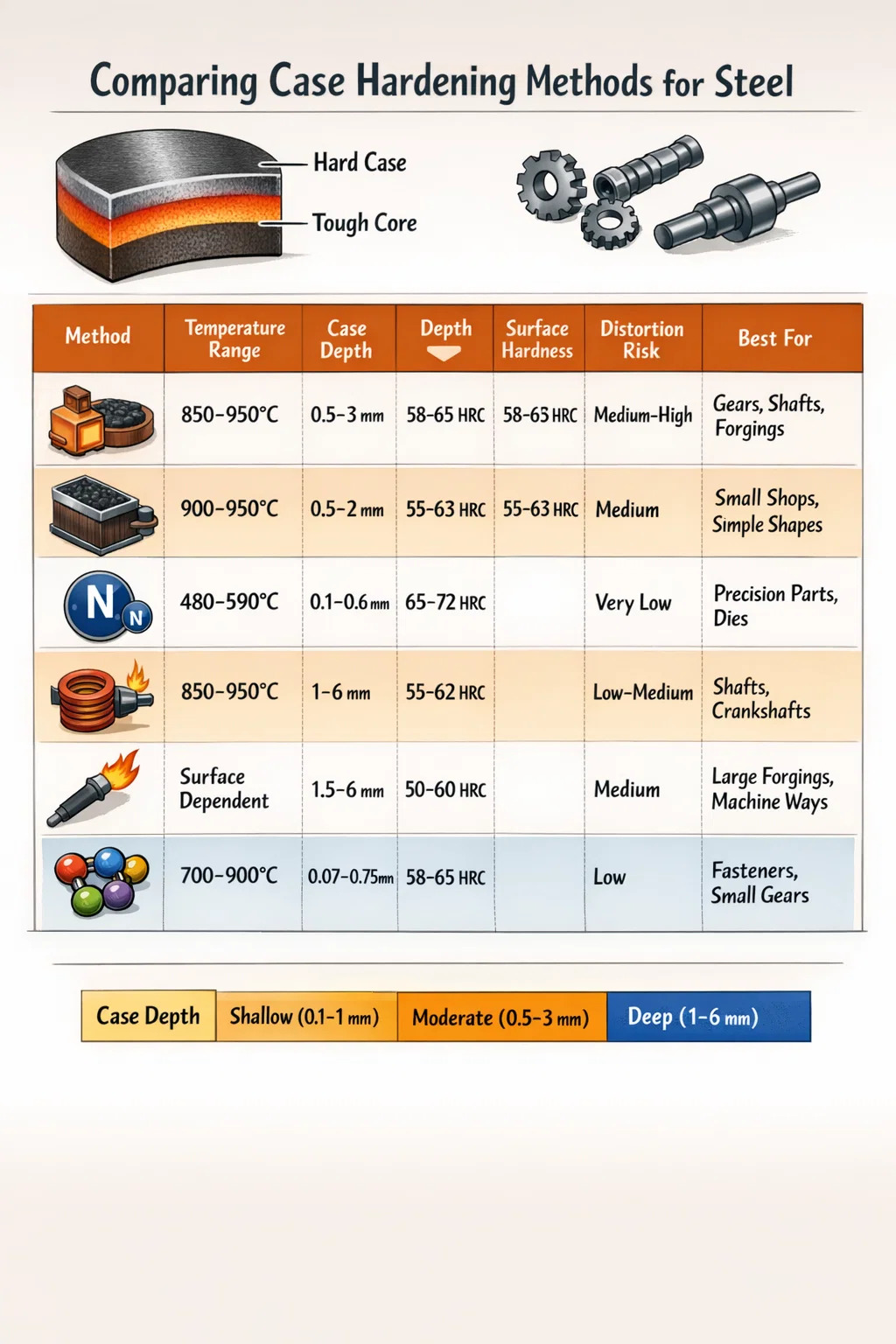
The table below summarizes the key differences between the most common case hardening methods to help in selecting the right process for a given application.
| Method | Temperature Range | Case Depth | Surface Hardness | Distortion Risk | Best For |
|---|---|---|---|---|---|
| Gas Carburizing | 850–950°C | 0.5–3 mm | 58–65 HRC | Medium–High | Gears, shafts, forgings |
| Pack Carburizing | 900–950°C | 0.5–2 mm | 55–63 HRC | Medium | Small shops, simple shapes |
| Nitriding | 480–590°C | 0.1–0.6 mm | 65–72 HRC equiv. | Very Low | Precision parts, dies, molds |
| Induction Hardening | 850–950°C (surface) | 1–6 mm | 55–62 HRC | Low–Medium | Shafts, crankshafts, rails |
| Flame Hardening | Surface dependent | 1.5–6 mm | 50–60 HRC | Medium | Large forgings, machine ways |
| Carbonitriding | 700–900°C | 0.07–0.75 mm | 58–65 HRC | Low | Fasteners, small gears |
Steel Grades Best Suited for Case Hardening
Not every steel grade responds to case hardening the same way. The choice of base material significantly affects the achievable case depth, core toughness, and dimensional stability after treatment. In steel forging applications, matching the correct grade to the case hardening process is fundamental to part performance.
Low-Carbon Steels for Carburizing
- AISI 1018 / 1020: The most common and economical choice. Used for shafts, pins, and general steel forging components where surface wear resistance is needed but cost must be controlled. Easy to machine before treatment.
- AISI 8620: A nickel-chromium-molybdenum alloy steel widely used in gear and shaft production. It carburizes reliably and offers excellent core toughness after heat treatment, making it a benchmark grade for steel forging of drivetrain components.
- AISI 9310: Used in high-performance aerospace and heavy-duty gear applications. Offers exceptional core strength and case hardenability due to high nickel content.
- AISI 4118 / 4320: Chromium-molybdenum grades with good hardenability. Used in transmission gears and forgings requiring deeper case depths and better fatigue resistance.
Alloy Steels for Nitriding
- AISI 4140: A versatile chromium-molybdenum steel that responds well to gas nitriding. Frequently used for tool holders, spindles, and precision shafts in steel forging equipment.
- AISI 4340: A high-strength nickel-chromium-molybdenum alloy steel. After nitriding, it achieves an excellent combination of surface hardness and core toughness. Common in aerospace forgings and structural components.
- Nitralloy 135M: Specifically developed for nitriding, containing aluminum as a nitride-forming element. Produces some of the highest surface hardness values achievable through nitriding, often exceeding 1000 HV.
Medium-Carbon Steels for Induction and Flame Hardening
- AISI 1045: A widely used medium-carbon steel for induction hardening. Common in shafts, axles, and agricultural implement forgings. Achieves 55–60 HRC on the surface after induction treatment.
- AISI 4140 / 4340: Also suitable for induction hardening when quenched from high surface temperatures. Used in crank pins, drill collar forgings, and heavy engineering components.
- AISI 1060 / 1080: Higher carbon content makes these suitable for rail and spring applications where flame hardening is practiced on high-wear contact surfaces.
How Case Hardening Interacts with the Steel Forging Process
In industrial manufacturing, case hardening is almost always a post-forging operation. Steel forging — whether open die, closed die (impression die), or roll forging — refines the grain structure of the steel and aligns the grain flow with the part geometry. This grain refinement improves the mechanical properties of the steel before any heat treatment is applied.
After steel forging, parts are typically normalized or annealed to relieve forging stresses, then rough machined to near-final dimensions. Case hardening is applied at this stage. The sequence matters: if a part is finish machined before case hardening, the hardening process can cause minor dimensional changes (distortion) that push the part out of tolerance. Most manufacturers leave grinding or finish machining as the final step after hardening.
In carburizing of forgings, the fine grain structure produced during steel forging helps limit carbon diffusion variability and supports a more uniform case depth across complex geometries. Forgings with tight grain structure also show better fatigue resistance in the case-core transition zone, which is where fatigue cracks commonly initiate under cyclic loading.
For example, automotive transmission gears produced through closed die steel forging in 8620 steel are routinely carburized to a case depth of 0.8–1.2 mm, quenched, tempered, and then finish ground. This combination of forging and carburizing produces components capable of withstanding contact stresses exceeding 1500 MPa over millions of loading cycles — performance that neither process alone could achieve.
Controlling Case Depth and Hardness Consistency
One of the most common problems in case hardening is inconsistent case depth. This can cause premature surface fatigue, spalling, or cracking in service. Several variables govern case depth consistency, and controlling them is what separates quality heat treating from poor practice.
Temperature Uniformity in the Furnace
Temperature gradients within a furnace directly translate into case depth variation across a batch. A batch of gears processed in a furnace with a ±15°C temperature variation will see case depth differences of 10–15% across the load. Industrial gas carburizing furnaces are typically specified to maintain ±5°C uniformity throughout the working zone. Thermocouple calibration and furnace qualification (per standards like AMS 2750 or CQI-9) are standard practice in quality-controlled heat treating facilities.
Carbon Potential Control in Gas Carburizing
In gas carburizing, the carbon potential of the furnace atmosphere must be carefully regulated. Too high a carbon potential causes surface carbide networks to form — brittle, plate-like iron carbides at the grain boundaries that significantly reduce fatigue life. Too low a carbon potential results in insufficient surface carbon and an inadequately hard case. Most furnace systems use oxygen probes (shim stock probes or lambda probes) to continuously monitor and adjust carbon potential, targeting 0.8%–1.0% surface carbon for most gear and shaft applications.
Quench Severity and Fixture Design
Non-uniform quenching is another major cause of distortion and inconsistent hardness. Parts that enter the quench at different orientations, or where the quench medium flows unevenly around the part, will cool at different rates and produce different microstructures in different zones. Properly designed fixtures hold parts securely during quench and allow consistent quench media access to all surfaces. Oil temperature during quench is typically maintained at 40°C–80°C (100°F–175°F) for most steel forging applications — cold oil quenches too harshly, hot oil quenches too slowly.
Post-Treatment Inspection
Verification of case hardening results is done through destructive and non-destructive testing. Destructive testing involves cutting a cross-section from a sample coupon processed with the production batch, then measuring hardness at incremental depths using a Vickers microhardness tester to generate a hardness profile. The effective case depth is defined as the depth at which hardness drops to 550 HV (approximately 52 HRC) per ISO 2639. Non-destructive methods include magnetic Barkhausen noise analysis and eddy current testing, which can detect case depth and surface hardness anomalies without cutting the part.
Common Mistakes in Case Hardening and How to Avoid Them
Most case hardening failures in the field can be traced back to a small number of avoidable errors. Recognizing these errors in advance — whether working in a production shop or a small forge — prevents costly rework and part rejection.
- Wrong base material: Attempting to carburize high-carbon steel adds little benefit and can produce brittle carbide networks. Always confirm the carbon content of the base steel before selecting a case hardening method.
- Skipping the temper: Quenched steel without tempering is under enormous internal stress. Parts can crack hours after quenching if not tempered promptly. Always temper within a few hours of quenching, even if it is just a 1-hour soak at 160°C.
- Uneven heating before quench: A part that is not at a uniform austenitizing temperature when quenched will have a non-uniform microstructure. Ensure adequate soak time at the processing temperature before quenching. Thin sections may only need 15–20 minutes of soak; thick forgings may require an hour or more.
- Surface contamination: Oil, grease, or oxidation on the part surface before carburizing creates dead zones where carbon cannot diffuse. Parts must be degreased and lightly sandblasted or cleaned before processing.
- Undersized case for the application: A thin case (0.2 mm) on a heavily loaded gear will break through under contact stress, exposing the soft core and causing rapid wear or pitting. Match the case depth specification to the contact pressure and load the component will see in service.
- Overcarburizing: Excessive time or carbon potential produces a thick, brittle white layer of retained austenite and carbides at the surface. This layer can flake, dramatically reducing fatigue strength rather than improving it.
Applications Where Case Hardened Steel Forging Components Are Standard
Case hardening is not a niche treatment. It is embedded into standard production processes across many industries that rely on steel forging for structural and mechanical components.
- Automotive transmissions and differentials: Ring gears, pinions, and sun gears in automatic transmissions are forged from 8620 or 4320 steel and carburized to case depths of 0.9–1.4 mm. The combination of surface hardness and core toughness handles the repeated contact stress and shock loading of vehicle drivetrains over hundreds of thousands of kilometers.
- Aerospace structural forgings: Landing gear components, actuator shafts, and bearing journals in aircraft are often made from 4340 steel, nitrided or carburized to provide wear resistance while maintaining the high strength and toughness required by aerospace specifications such as AMS 6415.
- Mining and construction equipment: Track pins, bushings, bucket teeth, and excavator boom pins are forged from alloy steels and case hardened to resist abrasive wear from contact with rock and soil. Case depths of 2–4 mm are common in these applications to provide durability under extremely harsh conditions.
- Crankshafts and camshafts: Automotive crankshafts, often forged from 1045 or microalloyed steels, are induction hardened at the journal surfaces to achieve localized surface hardness while the rest of the shaft retains toughness. Journal hardness of 55–60 HRC extends bearing life significantly compared to untreated surfaces.
- Hand tools and cutting tools: Chisels, punches, and dies made from 1020 steel can be pack carburized at home to produce a hard cutting edge. This is one of the oldest applications of case hardening and remains relevant for smiths and tool makers working outside of industrial settings.