

 英语
英语 德语
德语 阿拉伯语
阿拉伯语

Technical Features and Specifications
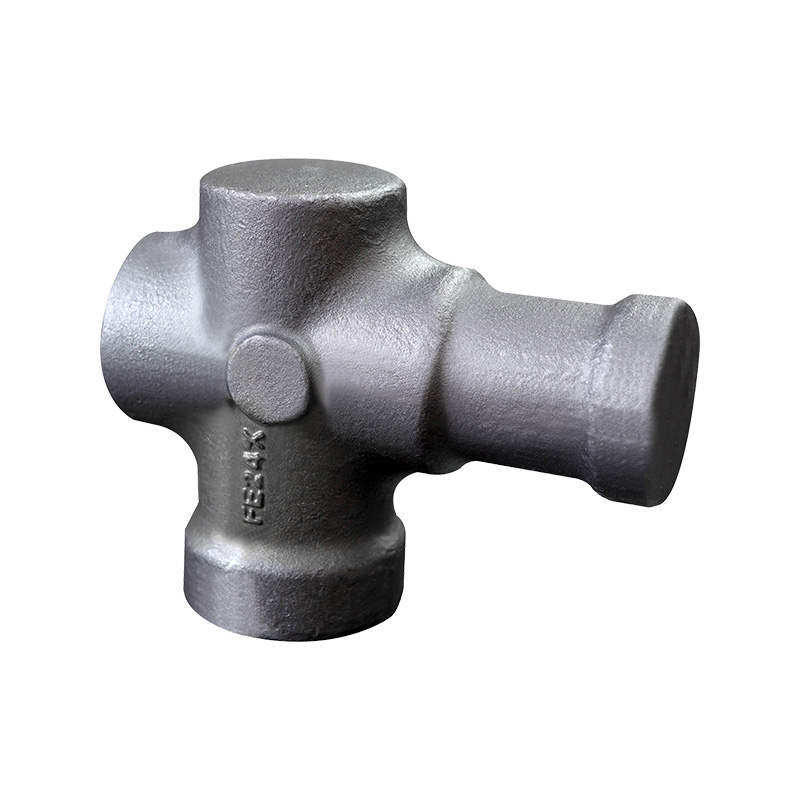
Forged tees are manufactured to maintain hydraulic efficiency while providing maximum structural containment.
| Feature | Specification Detail |
|---|---|
| Standard Types | Equal Tee, Reducing Tee, Cross Tee. |
| Design Codes | ASME B16.9 (Butt-weld), B16.11 (Socket/Threaded). |
| Materials | A105, A182 F11/F22, F304/316L, High-Yield Carbon Steel. |
| Pressure Classes | Up to 9000lb for forged socket weld fittings. |
The internal bore of a forged tee is precision-machined to ensure a smooth transition, minimizing the "pressure drop" across the fitting. For reducing tees, the internal taper is carefully designed to prevent cavitation, which can occur when high-velocity fluids enter a smaller branch. Every tee is subject to non-destructive testing, including Ultrasonic (UT) and Dye Penetrant (PT) inspection at the crotch area to ensure no cracks were formed during the forging process.
-
 Development Conceptscientific and technological innovation as the driving force.
 -
 Quality PolicyPeople, integrity, truth-seeking, innovation
 -
 Core ValueCommon development to achieve symbiosis and win-win.
Selection and Procurement Tips
When procuring forged tees, the focus should be on branch reinforcement and flow dynamics:
- Branch Size Ratio: For reducing tees, if the branch is significantly smaller than the header, ensure the forging maintains a minimum wall thickness at the intersection to handle high-pressure loads.
- Schedule Match: The wall schedule of all three ends must match the mating pipe (e.g., Sch 80 header to Sch 40 branch) to ensure correct weld preparation.
- Hydraulic Bulge vs. Extrusion: Ask the manufacturer about the forging method. Bulge forging provides excellent dimensional consistency for smaller sizes, while extrusion is preferred for larger, heavy-wall tees.
- End Preparation: Specify if the ends should be beveled for butt-welding, or machined for socket-welding or threading.
For high-temperature steam service, always verify the alloy content (Cr-Mo) to ensure the tee will resist "creep" deformation over decades of use.
Advantages of Forged Over Welded Tees
The use of a single-piece forged tee provides significant structural and safety advantages over "fabricated" or welded-on branch connections.
| Advantage | Operational Benefit |
|---|---|
| No Weld Seams | Eliminates the risk of weld failure at the high-stress branch intersection. |
| Seamless Flow | Smooth internal radii reduce turbulence and pressure loss. |
| Fatigue Life | Forged grain flow provides superior resistance to vibration-induced fatigue. |
| Compactness | Takes up less space than a fabricated tee with reinforcement pads. |
Forged tees are especially critical in "Pigging" operations. The smooth internal profile of a forged tee ensures that a pipeline pig can pass through the main header without getting caught or damaged at the branch opening. Furthermore, the structural strength of the forged tee allows it to support the weight of heavy valves or instrumentation mounted on the branch without needing extra pipe supports.
Global Industry Applications
Forged tees are ubiquitous in high-pressure piping across all heavy industrial sectors.
| Industry | Usage Context |
|---|---|
| Power Generation | High-pressure steam distribution and boiler headers. |
| Oil & Gas Upstream | Production manifolds and gathering systems. |
| Petrochemicals | Ethylene cracker transfer lines and flare headers. |
| Marine/Offshore | Firewater systems and ballast water distribution. |
In nuclear power plants, forged tees are used in primary cooling loops where safety is the absolute priority. The absence of welds at the branch connection reduces the amount of required in-service inspection (ISI), saving significant time and reducing radiation exposure for maintenance crews. Their reliability is unmatched for the transport of high-energy fluids.
- Q: What is an "Equal Tee"?
- A: An equal tee has the same nominal diameter for all three openings (the header and the branch). It is used when the flow is divided into lines of the same size.
- Q: Can forged tees be used for high-velocity gas?
- A: Yes, the seamless forged construction and smooth internal geometry make them ideal for high-velocity gas, as they minimize the noise and vibration caused by turbulence at the branch.