

 英语
英语 德语
德语 阿拉伯语
阿拉伯语

Content
- 1 What Elements Is Steel Made Of: The Direct Answer
- 2 Iron and Carbon: The Two Foundation Elements
- 3 Common Alloying Elements Added to Steel
- 4 Trace and Residual Elements That Still Matter
- 5 How Elements Shape Steel's Internal Microstructure
- 6 Steelmaking and Refining: How Element Content Is Controlled
- 7 How Element Content Behaves During the Steel Forging Process
- 8 Element Composition Across Common Steel Grades
- 9 Stainless Steel Family: Element Variations Explained
- 10 Tool Steel and High-Performance Alloy Elements
- 11 Carbon Equivalent: Combining Elements Into One Number
- 12 Why Precise Element Control Matters for Forged Steel Parts
- 13 Frequently Asked Questions
- 13.1 What is the single most important element in steel besides iron?
- 13.2 Can steel exist without carbon at all?
- 13.3 Why does stainless steel contain so much chromium?
- 13.4 Does higher alloy content always mean stronger steel?
- 13.5 Why do forged parts specify exact element percentages rather than just a grade name?
- 13.6 What happens if sulfur content in steel is too high before forging?
- 13.7 Is iron content ever listed on a steel specification sheet?
- 13.8 Why do some grades add boron when chromium and molybdenum already improve hardenability?
- 13.9 What is the difference between a hot rolled and a forged product made from the same steel grade?
- 13.10 How do engineers decide which alloying elements to specify for a new forged part?
What Elements Is Steel Made Of: The Direct Answer
Steel is fundamentally an alloy of iron and carbon, with carbon typically making up between 0.02% and 2.14% of the total weight. Beyond these two core elements, most commercial steel also contains manganese, silicon, phosphorus, and sulfur in varying amounts, along with intentionally added alloying elements such as chromium, nickel, molybdenum, vanadium, copper, boron, titanium, and niobium. In plain carbon steel, iron accounts for roughly 98% to 99.5% of the material, while in alloy grades used for steel forging and heavy machinery components, iron content can drop to 70% or lower once chromium, nickel, and other elements are blended in at higher percentages. The exact combination of elements determines whether a batch of steel becomes soft structural plate, hardened tool steel, corrosion-resistant stainless steel, or a forged alloy engineered to survive extreme mechanical stress.
Understanding this elemental makeup matters because every additional element changes how the steel behaves during melting, rolling, and forging. A buyer sourcing forged flanges, shafts, or gears needs to know not just the grade name but the actual percentage ranges of each element, since those numbers dictate hardness, ductility, weldability, machinability, and long-term wear resistance. In practice, no two heats of steel are chemically identical down to the last decimal point, which is why mills issue a heat-specific composition record for every batch that leaves the furnace.
The remainder of this guide walks through each element individually, explains how those elements interact once the steel is heated and shaped through forging, and closes with a detailed reference table and frequently asked questions covering the most common points of confusion buyers and engineers run into when reading a chemical composition sheet.
Iron and Carbon: The Two Foundation Elements
Iron is the base metal that gives steel its bulk, but pure iron on its own is relatively soft and lacks the strength needed for structural or mechanical use. Adding carbon transforms iron into steel by locking carbon atoms into the iron's crystal lattice, a process that restricts the movement of dislocations within the metal and dramatically raises hardness and tensile strength. This relationship is not linear across the entire range. Low carbon steel, sometimes called mild steel, holds carbon between roughly 0.05% and 0.25% and stays soft enough to bend, weld, and machine with ease. Medium carbon steel sits between 0.25% and 0.60% carbon and strikes a balance between strength and workability, which is why grades like 1045 and 4140 are common choices for forged automotive and industrial parts. High carbon steel climbs to 0.60% through 1.50% carbon and is prized for cutting edges and wear surfaces, though it becomes noticeably harder to weld or bend without cracking.
Iron itself exists in more than one crystal form depending on temperature, and this behavior is the entire reason carbon has such an outsized effect on steel. Below about 912°C, iron holds a body-centered cubic arrangement called ferrite, which can only dissolve a tiny fraction of a percent of carbon. Between roughly 912°C and 1394°C, iron shifts into a face-centered cubic arrangement called austenite, which can dissolve far more carbon, up to about 2.14% at its maximum. This difference in solubility is what allows heat treatment to work at all: heating steel into the austenite range dissolves carbon evenly throughout the structure, and then rapid cooling traps that carbon in a strained, supersaturated arrangement called martensite, which is extremely hard but brittle unless tempered afterward.
Why Carbon Content Cannot Simply Be Maximized
Raising carbon content increases yield strength and hardness, but it comes at a direct cost to ductility, impact toughness, and weldability. Once carbon content passes approximately 0.23%, weld joints become prone to cracking unless preheating and controlled cooling are used. This is one reason structural steels intended for welding are kept below 0.25% carbon, while steel forging operations producing non-welded, heat-treated components can push carbon higher to achieve superior hardness after quenching and tempering. Engineers refer to this trade-off constantly when selecting a grade, since a part that needs both strength and the ability to absorb sudden impact without shattering, such as a forged crankshaft or a structural pin, usually lands in the medium carbon range rather than at either extreme.
How Carbon Content Is Measured and Verified
Modern steel producers verify carbon content using optical emission spectrometry, where a small spark is struck on a polished sample and the light emitted is analyzed to identify and quantify every element present within seconds. Combustion analysis is used as a secondary check for carbon and sulfur specifically, burning a small sample in a controlled oxygen atmosphere and measuring the resulting carbon dioxide. Both methods have replaced older wet chemical titration techniques almost entirely because they are faster and repeatable across large production volumes, which matters enormously to forging operations that need consistent chemistry heat after heat.
| Steel Classification | Carbon Content Range | Typical Application |
|---|---|---|
| Low Carbon (Mild) | 0.05% - 0.25% | Automotive body panels, structural beams |
| Medium Carbon | 0.25% - 0.60% | Forged shafts, gears, crankshafts |
| High Carbon (Tool) | 0.60% - 1.50% | Cutting tools, dies, blades |
| Ultra-High Carbon | 1.25% - 2.00% | Specialty wear components, wire |
| Cast Iron Threshold | Above 2.14% | No longer classified as steel |
Trace and Residual Elements That Still Matter
Not every element in steel is added on purpose. Phosphorus and sulfur enter the mix as residual byproducts of the raw ore and scrap used in melting, and mills work to keep both below strict limits because of how disruptive they are to mechanical performance.
Phosphorus
Phosphorus segregates toward grain boundaries during solidification, making the steel brittle at room temperature, a defect known as cold shortness. Most specifications cap phosphorus at 0.04% or lower, since even small increases can cause forged parts to crack under impact loading. Free-machining steel grades are a notable exception, where phosphorus is intentionally raised alongside sulfur to make chip formation easier during high-speed machining, trading some toughness for improved cutting performance.
Sulfur
Sulfur causes the opposite problem at high temperature, known as hot shortness, where the steel becomes crumbly and prone to tearing during hot rolling or forging. Manganese is deliberately added in a ratio to sulfur content specifically to neutralize this effect by forming manganese sulfide inclusions instead of the more damaging iron sulfide, which has a much lower melting point and would otherwise sit at grain boundaries as a liquid film during hot working.
Oxygen, Nitrogen, and Hydrogen
Trace gases absorbed during melting can also affect steel quality. Oxygen forms non-metallic inclusions that weaken the matrix, nitrogen can cause aging embrittlement over time, and hydrogen is notorious for causing delayed cracking in thick forged sections if it is not removed through vacuum degassing before the steel is cast and forged. Modern electric arc furnace and ladle refining practices have made control of these trace gases far more precise than in past decades, which is part of why forged steel components produced today carry more consistent mechanical properties than equivalent parts made a generation ago.
Other Residual Elements
Scrap-based steelmaking, which now supplies a large share of global production, can introduce small residual amounts of tin, arsenic, and antimony carried over from mixed scrap sources. These elements are not intentionally added and typically stay below 0.05% each, but in combination they can contribute to temper embrittlement in heavy forged sections that undergo slow cooling through a specific intermediate temperature range. Producers supplying critical forgings monitor the combined total of these tramp elements rather than treating each one in isolation.
How Elements Shape Steel's Internal Microstructure
The percentages of each element matter less on their own than how they influence the microscopic crystal structure that forms as the steel cools. Four structures come up repeatedly in any discussion of forged steel performance.
Ferrite
Ferrite is the soft, magnetic, body-centered cubic form of iron that dominates low carbon steel at room temperature. It offers excellent ductility but limited strength on its own, which is why pure ferritic structures are typically reserved for parts that prioritize formability over hardness.
Pearlite
Pearlite is a layered structure of alternating ferrite and iron carbide that forms as medium and high carbon steel cools slowly from the austenite range. The fine, alternating layers give pearlite a useful balance of strength and moderate ductility, and it is the dominant structure in normalized medium carbon forgings that are not further heat treated.
Martensite
Martensite forms when austenite is cooled too quickly for carbon atoms to escape the crystal lattice in an orderly way, trapping them in a highly strained structure that is very hard but brittle. Nearly every quenched and tempered forging, including 4140 and 4340 components, passes through a martensitic stage before tempering reduces the brittleness while retaining most of the added strength.
Bainite
Bainite forms at cooling rates between those that produce pearlite and those that produce martensite, and it offers an appealing combination of strength and toughness without the tempering step martensite requires. Alloying elements such as manganese, chromium, and molybdenum widen the cooling rate window in which bainite forms, giving forging engineers more flexibility in thick sections where the core cools more slowly than the surface.
Every alloying element discussed earlier in this guide ultimately earns its place in a steel specification because of how it shifts the boundaries between these four structures, either by slowing the cooling rate needed to avoid pearlite, by stabilizing austenite at lower temperatures, or by pinning grain boundaries so that whichever structure forms stays fine and uniform rather than coarse.
Steelmaking and Refining: How Element Content Is Controlled
Element percentages are not simply mixed together like a recipe. They are the end result of a sequence of refining steps that each remove or add specific elements in a controlled order.
- Raw material charging begins with either iron ore reduced in a blast furnace to produce liquid pig iron, or recycled steel scrap melted in an electric arc furnace, with the choice between routes largely determined by regional energy costs and scrap availability.
- Primary refining in a basic oxygen furnace or electric arc furnace blows oxygen through the melt to strip out excess carbon, silicon, and phosphorus from the raw iron, bringing the composition down toward a rough target before finer adjustments begin.
- Ladle metallurgy follows, where the melt is transferred to a separate vessel and precise additions of manganese, chromium, nickel, molybdenum, and other alloying elements are made to hit the exact target chemistry for the intended grade.
- Vacuum degassing removes dissolved hydrogen, nitrogen, and residual oxygen, which is especially critical for steel destined for large forged sections where trapped gas can cause internal flaking or cracking once the part cools.
- Continuous casting solidifies the refined melt into billets, blooms, or slabs, and a sample from this stage becomes the official heat analysis that travels with the material through rolling and eventually into the forging shop.
Each of these stages exists specifically to control element content within a narrow band, and any shortcut taken at one stage shows up later as an inconsistency that a forging press will expose immediately in the form of surface cracking or uneven grain flow.
How Element Content Behaves During the Steel Forging Process
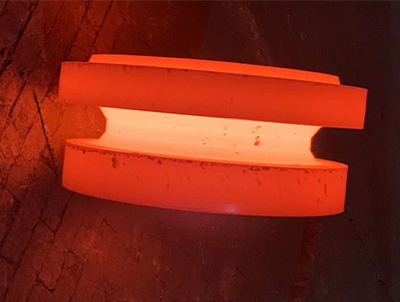
Steel forging reshapes a heated billet using compressive force, and the elemental composition of that billet directly governs how it responds under the hammer or press. Understanding this sequence helps explain why forging specifications reference exact chemistry rather than just a grade name.
- The billet is heated into the austenitic temperature range, typically between 1100°C and 1250°C for medium carbon and low alloy grades, where the iron-carbon structure becomes soft enough to deform without cracking.
- Carbon and alloying elements such as chromium and molybdenum raise the temperature at which the material begins to soften, which is why higher-alloy forging billets require tighter furnace control to avoid either under-heating, which risks cracking, or over-heating, which coarsens the grain structure.
- During deformation, elements like vanadium and niobium pin grain boundaries in place, keeping the crystal structure fine even as the metal is compressed and reshaped, which directly improves the strength and fatigue life of the finished forging.
- After forging, the part is cooled and often heat treated. Molybdenum and chromium content determine how deeply the piece can be hardened during quenching, while manganese content influences how the steel responds to tempering afterward.
- Sulfur and phosphorus levels are checked before forging begins, since forgings with excess sulfur are prone to internal tearing under the compressive stress of the hammer, and excess phosphorus increases the risk of cracking once the part cools below its ductile-to-brittle transition point.
This is why forging suppliers typically publish a full chemical composition sheet alongside mechanical property data, rather than relying on the grade designation alone. Two batches labeled the same grade can still behave differently in the press if their manganese-to-sulfur ratio or trace element content varies even slightly.
Grain Flow and Element Distribution
One benefit unique to forging, compared with casting or machining from bar stock, is that the compressive deformation aligns the internal grain structure along the shape of the finished part rather than cutting across it. Alloying elements that refine grain size, particularly vanadium, titanium, and niobium, amplify this benefit because a finer starting grain size translates into a more continuous, higher-integrity flow line once the part is fully forged, which is a major reason forged components consistently outperform cast or machined equivalents in fatigue-critical applications such as crankshafts, connecting rods, and gear blanks.
Temperature Control Across Different Alloy Families
Plain carbon steel billets tolerate a relatively wide forging temperature window, but as chromium, molybdenum, and nickel content rises, that window narrows considerably. Highly alloyed tool steel and stainless steel billets often need to stay within a band as narrow as 50°C to avoid either incomplete deformation at the low end or excessive grain growth and potential incipient melting of low-melting-point inclusions at the high end. This is one reason forging shops that specialize in stainless or high alloy work maintain tighter furnace instrumentation and more frequent temperature checks than shops focused purely on plain carbon steel.
Element Composition Across Common Steel Grades
Steel grade naming systems, most notably the AISI and SAE four-digit codes, are built directly around element content. Reading a grade number correctly reveals most of what the steel is made of without needing a full lab report. In the standard four-digit system, the first two digits indicate the primary alloying element or family, while the last two digits approximate the carbon content in hundredths of a percent, so a grade like 4140 signals a chromium-molybdenum alloy family with roughly 0.40% carbon.
| Grade | Carbon | Key Alloying Elements | Common Use |
|---|---|---|---|
| 1018 | 0.18% | Mn 0.60% - 0.90% | General shafting, low-stress parts |
| 1045 | 0.45% | Mn 0.60% - 0.90% | Forged gears, axles |
| 4130 | 0.28% - 0.33% | Cr 0.80% - 1.10%, Mo 0.15% - 0.25% | Forged tubing, fittings, aerospace parts |
| 4140 | 0.38% - 0.43% | Cr 0.80% - 1.10%, Mo 0.15% - 0.25% | Forged shafts, tooling, fittings |
| 4340 | 0.38% - 0.43% | Ni 1.65% - 2.00%, Cr 0.70% - 0.90%, Mo 0.20% - 0.30% | Heavily stressed fatigue-loaded parts |
| 8620 | 0.18% - 0.23% | Ni 0.40% - 0.70%, Cr 0.40% - 0.60%, Mo 0.15% - 0.25% | Carburized forged gears, pins |
| 304 Stainless | 0.08% max | Cr 18% - 20%, Ni 8% - 10.5% | Corrosion-resistant fittings, vessels |
| 316 Stainless | 0.08% max | Cr 16% - 18%, Ni 10% - 14%, Mo 2% - 3% | Marine and chemical processing forgings |
| H13 Tool Steel | 0.32% - 0.45% | Cr 4.75% - 5.50%, Mo 1.10% - 1.75%, V 0.80% - 1.20% | Forged and machined die-casting dies |
Notice how iron content is never listed directly in these tables. It is simply understood as the remainder once carbon, manganese, chromium, nickel, and other elements are subtracted from 100%, which is why iron is sometimes called the balance element on a chemical composition sheet.
Stainless Steel Family: Element Variations Explained
Stainless steel is not a single material but a family of alloys grouped by how their elements arrange the underlying crystal structure. Understanding these subfamilies clarifies why element percentages shift so much across grades that all fall under the same general stainless label.
Austenitic Stainless Steel
Austenitic grades such as 304 and 316 rely on high nickel content, typically 8% or more, to keep the austenite structure stable even at room temperature rather than transforming into ferrite on cooling. This gives austenitic stainless excellent ductility and toughness, along with the added benefit of being non-magnetic, though it cannot be hardened through heat treatment the way carbon and low alloy forging steels can.
Ferritic Stainless Steel
Ferritic grades keep nickel content low or absent entirely and rely on chromium alone, usually between 10.5% and 18%, to provide corrosion resistance. Because these grades remain magnetic and cannot be significantly hardened by heat treatment, they are chosen more for cost-effective corrosion resistance in less demanding structural applications than for high-strength forged components.
Martensitic Stainless Steel
Martensitic stainless grades combine moderate chromium content, typically 12% to 18%, with enough carbon to allow the same quench-and-temper hardening response used in carbon and low alloy steel. This makes martensitic stainless the preferred family for forged stainless components that need both corrosion resistance and high hardness, such as valve components, cutlery, and certain pump shafts.
Duplex Stainless Steel
Duplex grades balance roughly equal parts austenite and ferrite by carefully controlling chromium, nickel, and nitrogen together, producing a structure that combines the strength of ferritic grades with much of the toughness and weldability of austenitic grades. This balance makes duplex stainless increasingly common in forged offshore and chemical processing fittings that face both high mechanical loads and aggressive corrosive environments.
Tool Steel and High-Performance Alloy Elements
Tool steel represents the far end of alloy complexity, where multiple strong carbide-forming elements are combined deliberately to achieve wear resistance and heat resistance well beyond what standard alloy steel can offer.
Cold Work Tool Steel
Cold work grades such as D2 rely on high chromium content, often 11% to 13%, combined with elevated carbon to form abundant hard chromium carbides throughout the microstructure. These carbides give the steel exceptional resistance to abrasive wear in applications like blanking dies and shear blades, though the high carbide volume can make the material more brittle than lower-alloy tool steel.
Hot Work Tool Steel
Hot work grades such as H13 use chromium, molybdenum, and vanadium together to resist softening at the elevated temperatures encountered in die-casting and forging dies themselves. Because these dies are repeatedly heated and cooled as hot metal is pressed or cast against them, resistance to thermal fatigue matters as much as raw hardness, which is why the element balance in hot work steel favors sustained high-temperature strength over maximum room-temperature hardness.
High-Speed Steel
High-speed steel pushes alloy content further still, combining tungsten or molybdenum with vanadium and sometimes cobalt to maintain a sharp cutting edge even as friction raises the tool's temperature during high-speed machining. The name reflects the original advantage these grades offered over older plain carbon tool steel, which lost its hardness and dulled quickly once cutting speeds and the resulting heat increased.
Carbon Equivalent: Combining Elements Into One Number
Because so many elements influence hardenability and weldability simultaneously, metallurgists use a single combined figure called carbon equivalent, or CE, to summarize the overall effect of the full chemistry in one value. A widely used version of the formula adds carbon to fractions of manganese, chromium, molybdenum, nickel, and copper content.
CE = %C + (%Mn / 6) + ((%Cr + %Mo + %Ni) / 15) + (%Cu / 40)
A higher carbon equivalent means the steel is more resistant to deformation and wears better, but it also means the material is more susceptible to hydrogen-induced cracking during welding and requires preheating before any weld joint is made. Forged components that will later be welded into a larger assembly, such as pressure vessel nozzles or structural connections, are often specified with a maximum carbon equivalent ceiling rather than just a maximum carbon percentage, since this single number captures the combined effect of every element at once.
As a practical reference point, plain low carbon steel typically produces a carbon equivalent below 0.35, which welds easily with minimal preheat. Medium carbon low alloy grades like 4140 commonly land between 0.55 and 0.70, requiring moderate preheat and controlled interpass temperature during welding. Tool steel and highly alloyed forging grades can push carbon equivalent above 0.90, at which point welding is generally avoided altogether in favor of mechanical joining or replacement of the forged part as a single piece.
Why Precise Element Control Matters for Forged Steel Parts
A forging operation applies enormous compressive force to a heated billet, and any inconsistency in element distribution shows up immediately as cracking, tearing, or uneven grain flow. Mills that supply billets for forging typically hold tighter tolerances on manganese, sulfur, and phosphorus than mills producing steel for simple rolled plate, because the forging process concentrates any weakness at the point of maximum deformation. A billet with slightly elevated sulfur that would cause no visible problem in a rolled sheet can split apart entirely when struck under a forging hammer.
This is also why reputable forging suppliers test each heat of steel and retain the chemical composition record for every batch, rather than relying on a general grade specification. Buyers sourcing forged flanges, couplings, valve bodies, or drive shafts benefit from requesting the actual heat analysis, since it reveals the real percentages of every element rather than just the nominal range printed in a catalog.
Element consistency also affects downstream machining after forging. A forged part with segregated manganese sulfide inclusions can machine unevenly, producing inconsistent surface finish and accelerated tool wear in some areas of the same component. Buyers who see unexplained variation in machining performance across supposedly identical forged parts often trace the root cause back to inconsistent element distribution within the original billet rather than any error in the machining process itself.
Frequently Asked Questions
What is the single most important element in steel besides iron?
Carbon is the single most influential element because it directly controls hardness, strength, and ductility more than any other addition. Every other element is layered on top of the iron-carbon relationship to fine-tune a specific property.
Can steel exist without carbon at all?
Not by the standard definition. A very low carbon alloy, sometimes below 0.01% carbon such as maraging steel, is technically classified as steel because it still relies on an iron matrix strengthened through other mechanisms, but the vast majority of commercial steel contains measurable carbon content.
Why does stainless steel contain so much chromium?
Chromium content above roughly 11% forms a thin, continuously self-healing chromium oxide layer on the surface of the steel. This layer blocks oxygen and moisture from reaching the iron underneath, which is what gives stainless steel its resistance to rust compared with ordinary carbon steel.
Does higher alloy content always mean stronger steel?
Not necessarily. Alloying elements change specific properties rather than simply adding strength across the board. Nickel, for example, primarily improves toughness and low-temperature performance rather than raw hardness, while chromium mainly improves wear resistance and corrosion resistance. The right combination depends entirely on how the finished part will be used.
Why do forged parts specify exact element percentages rather than just a grade name?
Because even small shifts in manganese, sulfur, or phosphorus content within the allowed range for a grade can change how the billet behaves under compressive force during forging. Exact heat chemistry lets engineers predict grain flow, cracking risk, and post-forging heat treatment response with much greater accuracy than a grade name alone.
What happens if sulfur content in steel is too high before forging?
Excess sulfur reacts with iron to form iron sulfide, which melts at a much lower temperature than the surrounding steel matrix. During hot forging, these low-melting inclusions can cause the billet to tear apart internally, a defect known as hot shortness that is largely prevented by adding enough manganese to bind the sulfur instead.
Is iron content ever listed on a steel specification sheet?
Iron is rarely listed as a specific percentage because it is treated as the balance of the composition after every other element is accounted for. A typical carbon steel specification will list carbon, manganese, phosphorus, sulfur, and silicon maximums, with iron simply understood to make up the remainder, usually 97% to 99% of the total weight.
Why do some grades add boron when chromium and molybdenum already improve hardenability?
Boron is added because it delivers a large hardenability improvement using only a few parts per million of material, which keeps alloy cost low compared with achieving the same hardenability increase through larger additions of chromium, molybdenum, or nickel. It is especially common in cost-sensitive fastener and structural grades where every fraction of a percent of alloy content affects the final price.
What is the difference between a hot rolled and a forged product made from the same steel grade?
Both start from the same chemical composition, but forging applies concentrated compressive force that aligns the internal grain flow along the shape of the part and closes any internal porosity left over from casting. Hot rolled bar stock has a more uniform, less directional grain structure. For fatigue-critical components, the aligned grain flow achieved through forging typically delivers better mechanical performance even though the underlying element chemistry is identical.
How do engineers decide which alloying elements to specify for a new forged part?
The selection usually starts from the mechanical requirements of the part, such as required tensile strength, impact toughness at the expected service temperature, and resistance to corrosion or wear, and then works backward to a grade whose established element ranges are known to deliver those properties reliably. Cost, weldability, and machinability are weighed alongside pure mechanical performance, since the most highly alloyed steel is rarely the most practical or economical choice for a given application.