

 英语
英语 德语
德语 阿拉伯语
阿拉伯语

Content
- 1 What Are the Alloys of Steel? A Direct Answer
- 2 The Main Categories of Steel Alloys
- 3 Key Alloying Elements and Their Effects on Steel
- 4 Common Alloy Steel Grades and Their Real-World Applications
- 4.1 AISI 4140 (Chromium-Molybdenum Steel)
- 4.2 AISI 4340 (Nickel-Chromium-Molybdenum Steel)
- 4.3 AISI 8620 (Nickel-Chromium-Molybdenum Carburizing Steel)
- 4.4 AISI 52100 (High-Carbon Chromium Bearing Steel)
- 4.5 P91 and P92 (9% Chromium Creep-Resistant Steels)
- 4.6 Hadfield Manganese Steel (Grade 1.3401 / ASTM A128)
- 5 Why Forging Transforms Alloy Steel Performance
- 6 Types of Forging Processes Used for Alloy Steel
- 7 Heat Treatment of Alloy Steel Forgings
- 8 Inspection and Quality Standards for Alloy Steel Forgings
- 9 Alloy Steel Forgings Across Key Industries
- 10 How to Select the Right Alloy Steel for Forged Components
- 11 Emerging Trends in Alloy Steel Forgings
What Are the Alloys of Steel? A Direct Answer
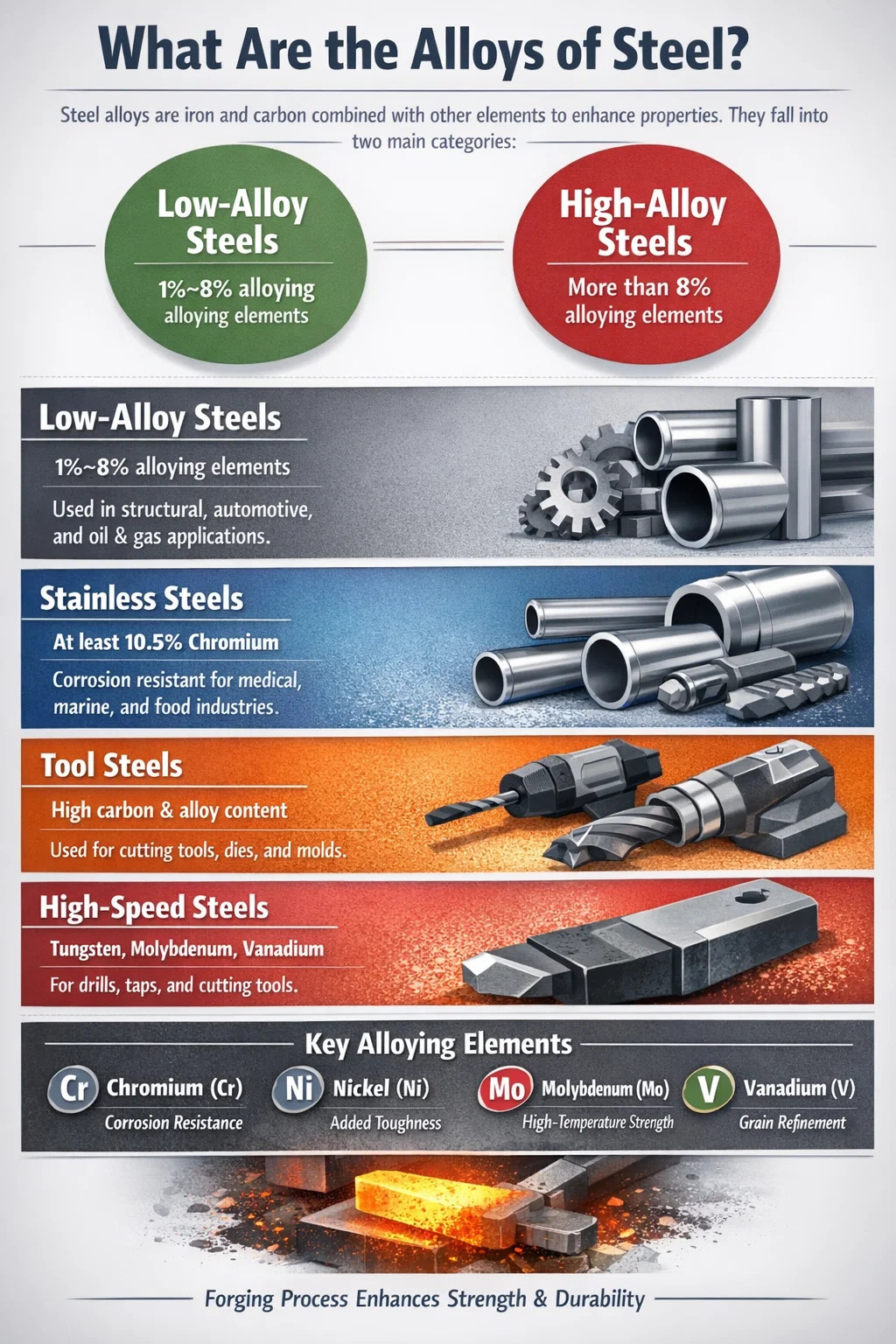
Steel alloys are created by combining iron and carbon with one or more additional alloying elements — such as chromium, nickel, molybdenum, vanadium, manganese, or tungsten — to produce materials with specific mechanical, thermal, or chemical properties that plain carbon steel cannot deliver on its own. The broad family splits into two major branches: low-alloy steels, which contain less than 8% total alloying elements, and high-alloy steels, which exceed that threshold and include stainless steels and tool steels.
Within that family, alloy steel forgings occupy a critical industrial niche. When alloy steel is shaped through forging — the process of compressing heated metal under high pressure — the resulting components display a refined grain structure, superior fatigue resistance, and tighter dimensional tolerance than castings or machined bar stock. Industries from oil and gas to aerospace to power generation rely heavily on alloy steel forgings for parts that must survive extreme stress, temperature, or corrosive environments.
The sections below break down the key alloy families, their compositions, the role of each alloying element, and how forging transforms raw alloy steel into high-performance components.
The Main Categories of Steel Alloys
Steel alloy classification follows several overlapping systems — by total alloy content, by primary alloying element, and by end-use application. The most practical framework for engineers and buyers is the combination of alloy content level and primary element identity.
Low-Alloy Steels
These steels contain between 1% and 8% total alloying elements. They are the workhorses of structural engineering, pressure vessel fabrication, and large-scale alloy steel forgings. Common grades include AISI 4130, 4140, 4340, and 8620. A Grade 4340 forging, for instance, can achieve a tensile strength of 1,080–1,470 MPa depending on heat treatment, making it a go-to choice for aircraft landing gear components, crankshafts, and heavy-duty gears.
High-Alloy Steels
When total alloying elements exceed 8%, the steel is classified as high-alloy. The most commercially significant subset is stainless steel, which requires at least 10.5% chromium to form the passive oxide layer that resists corrosion. High-speed tool steels, bearing steels, and heat-resistant alloys also fall here. Maraging steels — a specialized high-alloy group containing 18–25% nickel — achieve ultra-high strength (up to 2,400 MPa) through a martensite aging mechanism rather than conventional quench-and-temper treatment.
Stainless Steels
Stainless steel is technically a subset of high-alloy steel but is almost always discussed separately due to its scale and diversity. The four major families are austenitic (300 series), ferritic (400 series), martensitic (400 and 500 series), and duplex (2205, 2507). Duplex grades combine austenitic and ferritic microstructures and offer roughly twice the yield strength of standard 316L while maintaining comparable corrosion resistance — a reason they dominate offshore oil and gas piping and pump components, often produced as stainless alloy steel forgings.
Tool Steels
Tool steels are high-carbon, high-alloy grades engineered for hardness, wear resistance, and dimensional stability at elevated temperatures. Groups include water-hardening (W series), oil-hardening (O series), air-hardening (A series), D-type (high chromium), hot-work (H series), and high-speed steels (M and T series). A grade like M2 high-speed steel contains approximately 6% tungsten, 5% molybdenum, 4% chromium, and 2% vanadium, giving it exceptional red hardness for cutting tools operating near 600°C.
Key Alloying Elements and Their Effects on Steel
Each element added to steel produces specific, predictable changes in microstructure and properties. Understanding these effects is essential when specifying alloy steel forgings, because forging temperatures, cooling rates, and post-forge heat treatments must all account for alloy chemistry.
| Element | Typical Range (%) | Primary Effect | Common Grades |
|---|---|---|---|
| Chromium (Cr) | 0.5–30% | Corrosion resistance, hardenability, wear resistance | 4140, 52100, 316 |
| Nickel (Ni) | 0.5–36% | Toughness, low-temperature impact strength, corrosion resistance | 4340, 9% Ni cryogenic steel, maraging |
| Molybdenum (Mo) | 0.15–10% | High-temperature strength, creep resistance, pitting corrosion resistance | 4140, 316L, P91 |
| Vanadium (V) | 0.05–5% | Grain refinement, hardness, wear resistance at elevated temps | H13, M2, microalloyed HSLA |
| Manganese (Mn) | 0.3–14% | Hardenability, deoxidation, work hardening (Hadfield steel) | 1045, Hadfield, HSLA |
| Tungsten (W) | 1–20% | Red hardness, retention of hardness at high temperature | T1, T15 high-speed steel |
| Silicon (Si) | 0.1–4% | Deoxidation, oxidation resistance, spring steel strength | 9260 spring steel, silicon-electrical steel |
| Boron (B) | 0.0005–0.003% | Dramatic hardenability improvement at very low levels | 10B30, Boron HSLA grades |
Hardenability — the ability of a steel to be hardened to a given depth — is one of the most critical parameters for alloy steel forgings. A thick forging section that does not harden through its core will have a soft interior that limits load-bearing capacity. Chromium, molybdenum, and manganese all increase hardenability substantially, which is why grades like 4140 (Cr-Mo) and 4340 (Ni-Cr-Mo) are so widely specified for large forgings.
Common Alloy Steel Grades and Their Real-World Applications
Grade selection is rarely abstract — it is driven by specific operating conditions, geometry, and cost constraints. The grades below represent the most commercially significant alloy steels, many of which are routinely processed as alloy steel forgings.
AISI 4140 (Chromium-Molybdenum Steel)
Perhaps the most versatile low-alloy steel in production today, 4140 contains approximately 0.95% chromium and 0.20% molybdenum alongside 0.38–0.43% carbon. In the quenched and tempered condition it achieves tensile strengths of 850–1,000 MPa with good fatigue resistance. It is used for axle shafts, pump shafts, couplings, piston rods, and gears. As alloy steel forgings, 4140 components are found throughout the oil field — in drill collars, subs, and kelly bars — because the grade withstands torsional fatigue in downhole environments.
AISI 4340 (Nickel-Chromium-Molybdenum Steel)
The addition of approximately 1.65–2.00% nickel to the Cr-Mo base of 4340 dramatically improves toughness and through-hardening in large sections. This grade is the standard for aerospace structural forgings, including bulkheads, wing fittings, and landing gear components. It can be heat treated to 1,470 MPa minimum tensile strength while retaining Charpy impact values above 20 J at –40°C. AMS 6415 and AMS 6414 are the aerospace procurement specifications for this grade, with the latter requiring vacuum arc remelting (VAR) for superior cleanliness.
AISI 8620 (Nickel-Chromium-Molybdenum Carburizing Steel)
Grade 8620 is a case-hardening steel. Its low core carbon (0.18–0.23%) keeps the interior tough, while carburizing the surface to 0.8–1.0% carbon creates a hard, wear-resistant case. After carburizing and quenching, surface hardness reaches 58–62 HRC, while the core stays at 25–35 HRC. Gears, pinions, and camshafts are classic 8620 alloy steel forging applications across automotive and heavy equipment manufacturing.
AISI 52100 (High-Carbon Chromium Bearing Steel)
With about 1.0% carbon and 1.5% chromium, 52100 is designed for rolling contact fatigue life in bearing races and balls. It achieves surface hardness of 60–64 HRC after hardening. Its exceptionally tight cleanliness requirements — low sulfur, phosphorus, oxygen, and inclusion content — mean 52100 is often produced via electroslag remelting (ESR). Forged bearing rings in 52100 outperform machined bar stock due to favorable grain flow alignment with the ring geometry.
P91 and P92 (9% Chromium Creep-Resistant Steels)
P91 (9Cr-1Mo-V-Nb) and P92 (9Cr-2W-0.5Mo-V-Nb) are chromium-molybdenum steels engineered for steam systems in power generation plants operating above 565°C. P91 forgings used in valve bodies, steam chests, and turbine casings must maintain microstructural stability over design lifetimes of 200,000+ hours. These grades require careful post-weld and post-forge heat treatment (typically 760°C normalize and 760°C temper) to achieve the proper tempered martensite microstructure.
Hadfield Manganese Steel (Grade 1.3401 / ASTM A128)
Hadfield steel contains approximately 11–14% manganese and 1.0–1.4% carbon. Its defining characteristic is austenitic work hardening: under impact or compressive loading, the surface hardens from roughly 200 HB to over 550 HB while the bulk remains tough. Crusher jaws, rail crossings, and excavator bucket teeth rely on this property. Because Hadfield steel is difficult to forge (it work hardens during deformation), most large Hadfield components are cast rather than forged.
Why Forging Transforms Alloy Steel Performance
Forging is not just a shaping operation — it is a metallurgical process. When alloy steel is heated to its forging temperature range (typically 1,050–1,250°C depending on grade) and deformed under pressure, several simultaneous improvements occur in the metal's internal structure.
Grain Refinement
Casting produces coarse, randomly oriented grains with dendrite segregation. Forging breaks down this structure through repeated deformation and recrystallization cycles. The result is a fine, equiaxed grain structure — typically ASTM grain size 5–8 — that resists crack initiation and propagation. Fine-grained alloy steel forgings consistently exhibit 15–25% higher fatigue strength than equivalent castings of the same alloy composition.
Controlled Grain Flow
In a forged component, the grain flow lines — or "fiber lines" — follow the contour of the part's shape, much like wood grain following the shape of a branch. This is especially critical for alloy steel forgings used in rotating parts like crankshafts and gear blanks, where the principal stress direction aligns with the grain flow, maximizing strength and fatigue resistance. A machined bar stock crankshaft cuts across grain flow lines, exposing weaker transverse properties at exactly the high-stress locations.
Porosity and Inclusion Closure
Cast ingots contain shrinkage porosity and gas pores. The compressive forces during forging — which in large hydraulic presses can reach 50,000–80,000 tonnes — weld these pores shut and redistribute non-metallic inclusions into finer, more dispersed strings. This closure of internal voids is measured by the forging reduction ratio: a 4:1 reduction ratio is generally the minimum required to ensure adequate porosity closure, while critical aerospace alloy steel forgings often specify 6:1 or higher.
Mechanical Property Improvement — Quantified
Data comparing 4340 alloy steel in cast versus forged condition illustrates the improvement concretely:
- Tensile strength: Cast ~900 MPa vs. Forged ~1,080 MPa (quenched and tempered)
- Yield strength: Cast ~700 MPa vs. Forged ~980 MPa
- Charpy impact (longitudinal): Cast ~20 J vs. Forged ~60–80 J
- Fatigue limit (rotating bending): Cast ~380 MPa vs. Forged ~480 MPa
These differences explain why safety-critical components — pressure vessel flanges, turbine disks, automotive axle shafts — are almost exclusively produced as alloy steel forgings rather than castings.
Types of Forging Processes Used for Alloy Steel
Not all forging is the same, and the process selected significantly affects the microstructure, dimensional tolerance, and cost of the finished alloy steel forging.
Open-Die Forging (Free Forging)
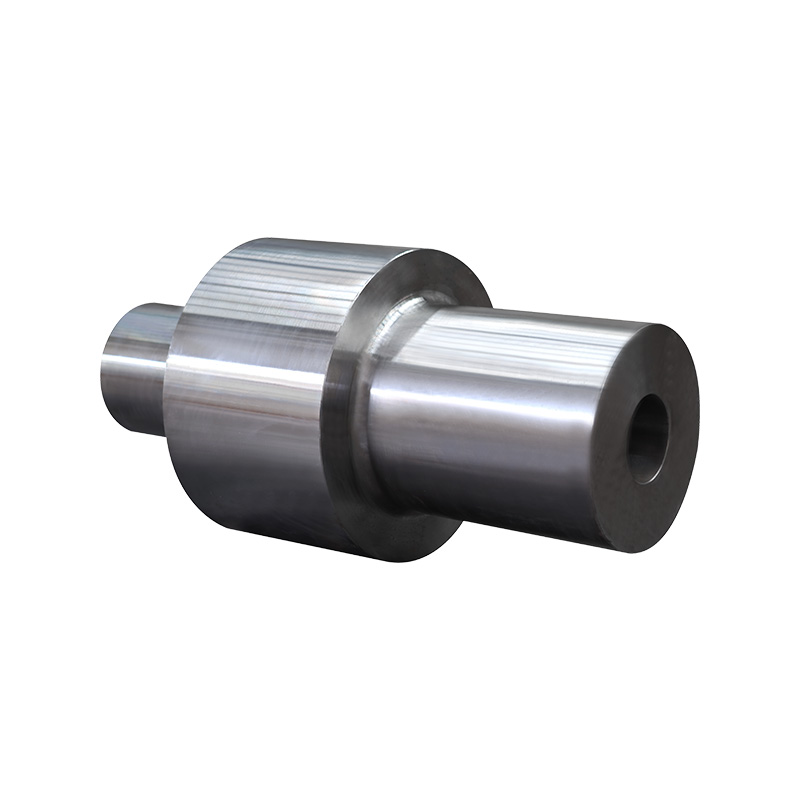
The billet is compressed between flat or simply shaped dies without full enclosure. This process is used for large, low-volume components: shafts up to 15 meters in length, rings several meters in diameter, and blocks for pressure vessels or turbine disks. Open-die forging allows the operator to reposition the workpiece repeatedly, achieving high reduction ratios and excellent internal soundness. Most alloy steel forgings destined for power generation (turbine rotors, generator shafts) and heavy industry are open-die forgings.
Closed-Die (Impression-Die) Forging
The alloy steel is confined within shaped die cavities that force the metal to fill the impression's geometry. This process is suited to medium-complexity shapes in high volumes, such as automotive connecting rods, gear blanks, valve bodies, and flanges. Dimensional tolerances of ±0.5 mm or better are achievable. Die costs are high — a set of forging dies for a connecting rod can cost $50,000–$200,000 depending on size and complexity — but per-piece costs fall sharply at volume.
Ring Rolling
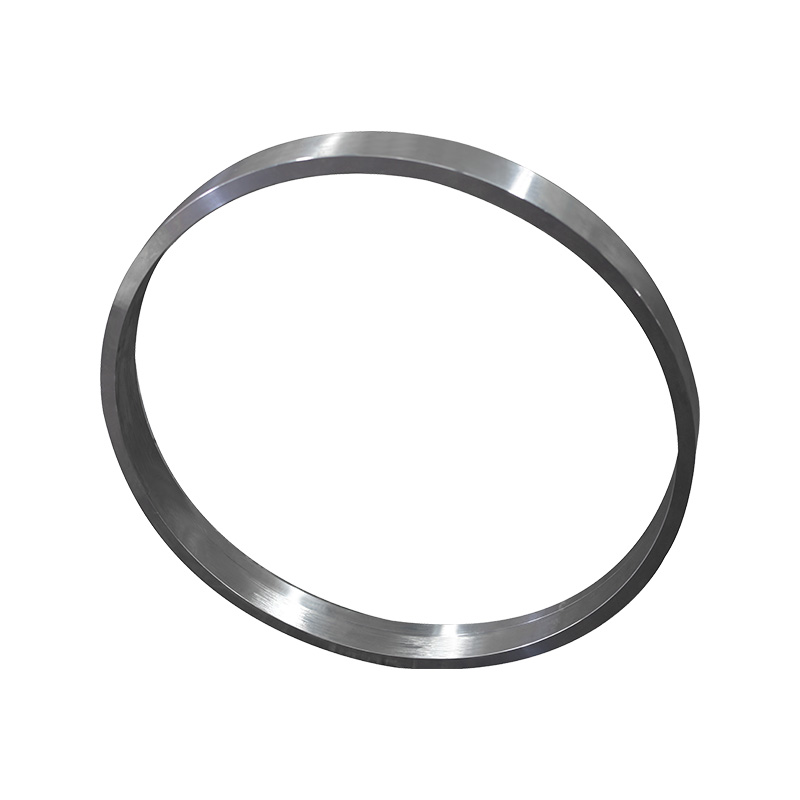
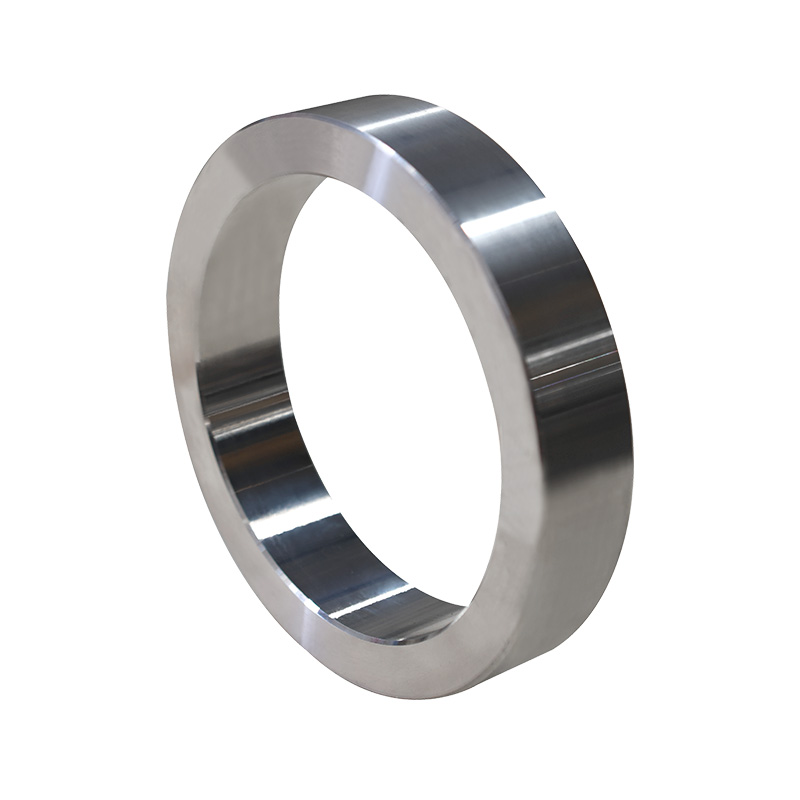
A specialized forging process where a hollow preform is progressively reduced in wall thickness and expanded in diameter between a driven roll and an idler roll. Ring rolling produces seamless rings with continuous circumferential grain flow that is ideal for bearing races, flanges, gear rims, and pressure vessel nozzles. Alloy steel forgings produced by ring rolling in grades like 4140, 4340, and F22 (2.25Cr-1Mo) are standard components in oil and gas wellhead equipment and industrial gearboxes.
Isothermal and Near-Isothermal Forging
For alloys with narrow hot-working windows — including high-alloy tool steels, titanium alloys, and nickel superalloys — the dies are heated to near the workpiece temperature to minimize thermal gradients and prevent premature hardening. This process produces exceptionally consistent microstructures but requires heated dies (often at 900–1,100°C) and slower press speeds, substantially increasing cost. Near-net-shape isothermal forgings minimize machining allowance, which is valuable when the alloy itself is expensive.
Heat Treatment of Alloy Steel Forgings
Forging sets the grain structure; heat treatment determines the final microstructure and mechanical properties. For alloy steel forgings, the three main treatment sequences are normalizing, quenching and tempering (Q&T), and annealing.
Normalizing
The forging is heated to 30–50°C above the upper critical temperature (Ac3) and air-cooled. This refines the grain structure, relieves residual forging stresses, and produces a uniform pearlitic-ferritic microstructure. Normalized 4140 achieves a tensile strength of approximately 655–860 MPa, adequate for many structural applications without further treatment. Normalizing also improves machinability compared to the as-forged condition.
Quenching and Tempering
Q&T is the standard treatment for alloy steel forgings requiring maximum strength and toughness. The forging is austenitized (typically 840–870°C for most Cr-Mo grades), then rapidly quenched in oil or water to form martensite, followed by tempering at 540–650°C to reduce brittleness while retaining most of the strength. A 4340 forging tempered at 540°C achieves approximately 1,470 MPa tensile strength and 1,172 MPa yield strength; tempering at 650°C reduces strength to around 1,030 MPa but raises impact toughness from ~28 J to ~80 J — a classic strength-toughness trade-off.
Solution Annealing for Stainless Alloy Steel Forgings
Austenitic stainless forgings (304, 316, 321) require solution annealing at 1,040–1,120°C followed by rapid water quench to dissolve chromium carbides and restore full corrosion resistance. If austenitic stainless is cooled slowly through the sensitization range (425–870°C) after forging, chromium carbides precipitate at grain boundaries, depleting adjacent zones of chromium and leaving them vulnerable to intergranular corrosion — a phenomenon known as sensitization. Proper solution annealing eliminates this risk.
Precipitation Hardening (Aging)
Applied to precipitation-hardening stainless steels (17-4 PH, 15-5 PH) and maraging steels, aging involves holding the forging at a specific temperature — typically 480–620°C — to precipitate fine intermetallic compounds (copper-rich precipitates in 17-4 PH; Ni₃Mo, Ni₃Ti in maraging steel) that block dislocation movement and increase hardness and strength. 17-4 PH in condition H900 (aged at 482°C) achieves 1,310 MPa tensile strength and 1,170 MPa yield, with good corrosion resistance — making it popular for aerospace structural alloy steel forgings where weight reduction matters.
Inspection and Quality Standards for Alloy Steel Forgings
Because alloy steel forgings are often safety-critical, quality requirements are intensive and typically defined by industry standards, customer specifications, and codes.
Relevant Standards and Specifications
- ASTM A105 — Carbon steel alloy steel forgings for ambient-temperature piping components
- ASTM A182 — Forged or rolled alloy and stainless steel pipe flanges and fittings for high-temperature service
- ASTM A336 — Alloy steel forgings for pressure and high-temperature components
- ASTM A508 — Quenched and tempered alloy steel forgings for pressure vessels, including nuclear reactor vessels
- AMS 6415 / AMS 6414 — Aerospace alloy steel forging specifications for 4340 grade
- EN 10250 — European standard for open-die steel forgings for general engineering purposes
- API 6A — Wellhead and Christmas tree equipment, covering forged valve bodies and spools in alloy steel
Non-Destructive Testing Methods
Large alloy steel forgings are routinely subjected to multiple non-destructive evaluation (NDE) methods:
- Ultrasonic Testing (UT) — Detects internal flaws (porosity, inclusions, laps) using high-frequency sound waves. Sensitivity is typically calibrated to detect flat-bottom hole (FBH) reflectors as small as 1.6 mm in diameter for aerospace parts.
- Magnetic Particle Inspection (MPI) — Detects surface and near-surface discontinuities in ferromagnetic alloy steel forgings by applying magnetic field and iron powder or fluorescent particles.
- Liquid Penetrant Testing (PT) — Used for non-ferromagnetic stainless alloy steel forgings to detect surface-breaking defects.
- Radiographic Testing (RT) — X-ray or gamma-ray examination for complex geometry forgings where UT access is limited.
Mechanical property verification — tensile, yield, elongation, reduction of area, Charpy impact — is always required from heat-representative test coupons. Hardness surveys at multiple locations confirm heat treatment uniformity through the forging cross-section.
Alloy Steel Forgings Across Key Industries
The demand for alloy steel forgings is broadly distributed across heavy industries, each with distinct alloy preferences driven by operating environment.
Oil and Gas
Wellhead Christmas trees, valve bodies, flanges, and subsea connector hubs are produced as alloy steel forgings in grades like F22 (2.25Cr-1Mo), F91 (9Cr-1Mo), and duplex stainless 2205. Subsea components must withstand pressures up to 15,000 psi and temperatures from –29°C to 180°C while resisting H₂S-induced sulfide stress cracking (SSC). NACE MR0175 / ISO 15156 specifies maximum hardness limits (typically 22 HRC maximum) for alloy steel forgings in sour service environments to prevent SSC.
Power Generation
Steam turbine rotors, generator shafts, and valve bodies for coal, gas, and nuclear power plants represent some of the largest and most demanding alloy steel forgings made. A single low-pressure turbine rotor for a 1,000 MW steam turbine can weigh over 70 tonnes and require 100+ hours of ultrasonic examination. Grades used include 26NiCrMoV14-5, 30CrMoV9, and for ultra-supercritical plants, modified 9–12% Cr steels (P91, P92, CB2).
Aerospace and Defense
Landing gear, actuator pistons, structural bulkheads, and engine mounts are produced as alloy steel forgings in 4340, 300M (modified 4340 with higher silicon and vanadium), Aermet 100, and 17-4 PH. 300M achieves tensile strengths exceeding 1,930 MPa with good fracture toughness (KIC > 66 MPa√m), making it the standard landing gear material for commercial and military aircraft. All aerospace alloy steel forgings are subject to full material traceability requirements from melt heat to finished part.
Automotive and Heavy Equipment
Crankshafts, connecting rods, camshafts, steering knuckles, wheel hubs, and differential ring gears are all produced as closed-die alloy steel forgings. The global automotive forging market exceeded $80 billion USD in 2023, with alloy steel representing the largest volume segment. Microalloyed HSLA grades (vanadium-bearing 1548, niobium-bearing steels) have gained market share because they achieve required strength after controlled cooling from forging temperature without a separate Q&T step — reducing energy consumption and manufacturing cost.
Mining and Construction
Bucket teeth, crusher hammers, shovel dipper lips, and drill bits for mining applications use alloy steel forgings in wear-resistant grades. Chromium-molybdenum alloy steel with medium-high carbon (0.35–0.50% C) heat treated to 400–500 HB is typical for crusher hammers. Rotary drill bits use alloy steel forgings in 4145H or modified 4145 grades, heat treated to meet API Specification 7-1 requirements for downhole tool connections.
How to Select the Right Alloy Steel for Forged Components
Alloy steel selection for forgings is a multi-variable engineering decision. The following framework covers the most critical selection criteria.
Step 1: Define the Stress State and Required Strength Level
Tensile, fatigue, torsional, or impact loading? A rotating shaft sees cyclic bending and torsion — fatigue strength governs, pointing to clean alloy steel forgings with fine grain and high cleanliness. A pressure vessel shell sees biaxial tensile stress at elevated temperature — creep resistance and fracture toughness govern, pointing to Cr-Mo grades like F22 or F91.
Step 2: Assess the Environment
Does the forging contact corrosive fluids, sour gas, seawater, or oxidizing gases at elevated temperature? Sour service demands hardness limits and NACE compliance. Marine environments may require duplex stainless alloy steel forgings. Oxidizing high-temperature environments require chromium contents above 9% for adequate oxidation resistance.
Step 3: Consider Section Size and Hardenability
A 25 mm diameter shaft can be through-hardened with a simple 4140. A 500 mm diameter forging requires a grade with much higher hardenability — 4340, or ideally a nickel-enhanced variant — to ensure the core achieves the target hardness after quenching. Grossmann hardenability charts and Jominy end-quench data for candidate grades are the primary tools for this analysis.
Step 4: Evaluate Weldability
If the forging will be welded to piping or plate, carbon equivalent (CE) governs hydrogen-induced cracking risk. The IIW formula CE = C + Mn/6 + (Cr+Mo+V)/5 + (Ni+Cu)/15 should be below 0.40% for weld-without-preheat; grades above this require preheat, interpass temperature control, and post-weld heat treatment (PWHT), adding cost and schedule.
Step 5: Factor in Machinability and Cost
High-alloy and high-hardness grades machine more slowly and wear tooling faster, increasing machining cost per part. 4140 machines roughly 40% faster than 4340 in the same heat-treated condition. Tool steels and high-alloy stainless grades require carbide tooling throughout. The total cost of an alloy steel forging includes raw material, forging, heat treatment, machining, and inspection — and alloy selection affects all of these.
Emerging Trends in Alloy Steel Forgings
The alloy steel forging industry is not static. Material developments and process innovations continue to expand what is achievable.
Microalloyed HSLA Steels Replacing Q&T Grades
High-strength low-alloy (HSLA) grades containing small additions of vanadium (0.06–0.12%), niobium (0.03–0.06%), or titanium achieve yield strengths of 550–700 MPa directly after controlled cooling from the forging temperature, eliminating the separate quench and temper cycle. This saves energy, reduces distortion risk, and shortens lead time. Adoption has been rapid in automotive connecting rods and truck axle beams.
Cleanness and Vacuum Metallurgy
Demands for higher fatigue life in aerospace and energy applications are pushing alloy steel forging producers toward vacuum induction melting (VIM) followed by vacuum arc remelting (VAR) or electroslag remelting (ESR). VIM+VAR double-melt alloy steel achieves oxygen content below 10 ppm and sulfur below 5 ppm, compared to 20–30 ppm oxygen in standard electric arc furnace plus ladle refining production. The reduction in non-metallic inclusions directly translates to improved high-cycle fatigue life — sometimes by a factor of 2–3×.
Simulation-Driven Forging Development
Finite element modeling (FEM) of forging processes using software such as DEFORM, FORGE, or Simufact now allows forging engineers to predict metal flow, strain distribution, temperature evolution, and die fill before any physical trial. This reduces the number of forging trials required for new alloy steel forging designs from 5–10 iterations to 1–2 in many cases, substantially reducing development cost and time to market.
Sustainable Forging Practices
Electric arc furnace (EAF) steelmaking using scrap already dominates alloy steel production. The next wave involves replacing natural gas combustion heating with induction heating or electric resistance furnaces for billet heating, reducing scope 1 CO₂ emissions from the forging plant. Several European forging companies have committed to carbon neutrality targets by 2040, with electrification of heating as a primary lever. At the same time, near-net-shape forging — minimizing material removed in machining — reduces material waste, which is important given the cost of specialty alloy steel.