

 英语
 德语
 阿拉伯语


Content
- 1 What Is Low Alloy Steel?
- 2 What Is Stainless Steel?
- 3 Low Alloy Steel vs Stainless Steel: Head-to-Head Comparison
- 4 Where Low Alloy Steel Is the Clear Winner
- 5 Where Stainless Steel Is the Clear Winner
- 6 Cost Comparison: Sticker Price vs Lifecycle Cost
- 7 Welding, Machining, and Heat Treatment Differences
- 8 How to Choose: A Decision Framework for Forged Components
- 9 Why the Forging Method Matters for Both Steels
- 10 Frequently Asked Questions
- 10.1 1. Which is stronger: low alloy steel or stainless steel?
- 10.2 2. Is stainless steel considered an alloy steel?
- 10.3 3. Can low alloy steel be used in outdoor or marine environments?
- 10.4 4. Why is 316 stainless steel more corrosion resistant than 304?
- 10.5 5. Does stainless steel need to be painted?
- 10.6 6. Can both steels be forged into the same shapes?
- 10.7 7. When should I choose low alloy steel over stainless steel?
- 10.8 8. What is the cheapest way to get corrosion resistance from a forged part?
- 11 Final Recommendation
The selection between low alloy steel and stainless steel is one of the most frequent material decisions in industrial forging, and there is a direct answer: choose low alloy steel when the part must carry high loads, absorb impact, resist wear, or stay within a tight budget; choose stainless steel when the part must resist corrosion, oxidation, staining, or media contamination. Low alloy steel gives you more mechanical strength per unit of cost. Stainless steel gives you a longer, lower-maintenance service life in demanding environments.
To make this concrete: the flange forgings on a natural gas pipeline are typically low alloy steel because the governing threats are internal pressure and mechanical shock. The trim inside the matching valve is often stainless steel because it sits in direct contact with the process medium and must survive corrosion and erosion. A crusher shaft in mining is low alloy steel; a seawater pump impeller is almost always stainless. Once you identify which failure mode matters most in your application, most of the ambiguity disappears.
What Is Low Alloy Steel?
Low alloy steel is a carbon steel to which controlled amounts of alloying elements have been added. The usual industry dividing line is 8% total alloying elements by weight: below that line, the steel is considered "low alloy"; above it, "high alloy". Most commercial low alloy steels actually contain between 1% and 5% of alloying elements, because that range delivers most of the practical benefits without a high-alloy price tag.
The alloying elements work in combination, and each one earns its place in the composition:
- Chromium (0.4 to 2.0%) – raises hardenability and creates stable carbides for wear resistance.
- Nickel (0.5 to 3.5%) – strengthens the ferrite phase and improves impact toughness at low temperatures.
- Molybdenum (0.15 to 0.6%) – adds high-temperature strength and suppresses temper embrittlement.
- Vanadium (0.03 to 0.15%) – refines the grain size and increases yield strength without hurting ductility.
- Manganese (0.8 to 1.8%) – improves hardenability and helps control sulfur during hot working.
When a forging buyer specifies low alloy steel, the shortlist usually includes a few established grades with predictable responses to heat treatment:
| Grade | Main Alloying Elements | Tensile Strength (MPa) | Typical Forged Parts |
|---|---|---|---|
| 4130 | Cr, Mo | 560 to 670 (annealed) | Aircraft fittings, hydraulic components |
| 4140 | Cr, Mo | 650 to 1000+ (quenched and tempered) | Shafts, gears, flanges, valve bodies |
| 4340 | Ni, Cr, Mo | 745 to 1200+ (quenched and tempered) | Heavy-duty axles, highly stressed machine parts |
| 8620 | Ni, Cr, Mo (low carbon) | 540 to 640 (core, after carburizing) | Carburized gears, cams, couplings |
Low alloy steel forgings are normally delivered in the annealed, normalized, or quenched-and-tempered condition. That is why forging and heat treatment are so closely linked: the deformation refines the grain structure, and the subsequent heat treatment sets the final strength-toughness balance.
What Is Stainless Steel?
Stainless steel is defined by chemistry: a minimum of 10.5% chromium by weight. The chromium reacts with oxygen to form a chromium oxide film (Cr2O3) only a few atomic layers thick. This film is self-healing: when the surface is scratched, it re-forms as long as oxygen is available. That behavior is the source of stainless steel's corrosion resistance.
Stainless steels are grouped into four main families, and each behaves differently in a forging operation:
- Austenitic (304, 304L, 316, 316L, 321) – 16 to 26% chromium and 6 to 22% nickel. Non-magnetic, excellent corrosion resistance and formability. Cannot be hardened by heat treatment; only by cold work. 316 adds molybdenum to resist chlorides.
- Martensitic (410, 420, 440C) – 11 to 14% chromium, low nickel. Magnetic and hardenable by quench and temper. Hardened condition gives good wear resistance, but corrosion resistance is lower than austenitic grades.
- Ferritic (430, 446) – 10.5 to 18% chromium, very low nickel. Magnetic, good resistance to stress corrosion cracking, moderate corrosion resistance.
- Duplex (2205, 2507) – roughly 21 to 25% chromium, 4 to 7% nickel, plus molybdenum and nitrogen. Mixed austenitic-ferritic structure; about twice the yield strength of 304/316 and excellent resistance to chloride stress corrosion cracking.
| Family | Typical Grades | Chromium % | Nickel % | Common Forged Parts |
|---|---|---|---|---|
| Austenitic | 304, 304L, 316, 316L | 16 to 20 | 8 to 14 | Valve trim, pump shafts, flanges |
| Martensitic | 410, 420, 440C | 11 to 14 | 0 to 1 | Valve stems, seats, couplings |
| Ferritic | 430, 446 | 10.5 to 18 | 0 to 1 | Turbocharger parts, fittings |
| Duplex | 2205, 2507 | 21 to 25 | 4 to 7 | Offshore flanges, manifold components |
In forged components, austenitic and martensitic grades dominate today, while duplex is growing quickly in oil and gas and offshore applications because it combines strength, weight reduction, and corrosion resistance in one package.
Low Alloy Steel vs Stainless Steel: Head-to-Head Comparison
The following table takes the starting point for nearly every selection: the properties that define how a material behaves under load, in a corrosive environment, and in the workshop.
| Property | Low Alloy Steel (heat-treated) | Austenitic Stainless (annealed) |
|---|---|---|
| Tensile strength | 550 to 1400 MPa | 480 to 620 MPa (cold work raises it) |
| Yield strength | 300 to 1200 MPa | 205 to 310 MPa |
| Hardness | Up to 58 to 62 HRC after hardening | 80 to 95 HRB (martensitic grades to 55 HRC) |
| Corrosion resistance | Low to moderate; needs coatings in wet service | Excellent; self-passivating oxide film |
| Wear resistance | Good to excellent after hardening | Moderate; galling risk in sliding contact |
| Weldability | Good with preheat and post-weld heat treatment | Good with low heat input; use low-carbon grades |
| Machinability | Fair to good (grade dependent) | Fair; work-hardens rapidly |
| Heat treatment response | Excellent; quench and temper is standard | Austenitic grades cannot be hardened |
| Max continuous service temp (air) | About 350 to 450 C | About 750 to 870 C |
| Relative material cost per kg | 1.0 (baseline) | 2.0 to 4.0 times baseline |
Reading the table, the fundamental trade-off becomes obvious: low alloy steel dominates on strength, hardness, heat treatment flexibility, and price; stainless steel dominates on corrosion resistance and high-temperature oxidation resistance. Neither material outclasses the other across every row.
Also note that these are typical ranges. The final properties of a forged part depend on forging reduction ratio, section thickness, heat treatment cycle, and final surface condition, so actual values must always be confirmed against the specific specification you are working to.
Where Low Alloy Steel Is the Clear Winner
Strength under load
Look at the numbers. A forged AISI 4140 shaft, quenched and tempered to a moderate hardness range, easily reaches 850 to 1000 MPa yield strength; an annealed 304 stainless bar sits at roughly 205 to 310 MPa yield, according to typical ASTM published data. For structural parts, gear shafts, axles, and flanges that must carry static or cyclic loads, low alloy steel lets the designer use a smaller, lighter section for the same load. That directly reduces material use, machining time, and weight.
Through-hardening and surface hardening
Low alloy steels respond strongly to quench and tempering. Grades like 4140 and 4340 can be hardened through thick sections to give a consistent combination of strength and toughness. They are also ideal for induction or flame hardening of localized zones, such as gear teeth or bearing journals, producing a hard wear surface while retaining a tough core. Austenitic stainless steels cannot be hardened by heat treatment at all, which is a decisive limitation for many mechanical components.
Wear resistance in mining and earthmoving
Mining equipment is one of the best examples. Crusher shafts, gear blanks, bucket components, and carrier rollers see abrasive dust, high impact peaks, and cyclic bending. Low alloy steel grades, typically supplied as quenched-and-tempered forgings, deliver the hardness and impact toughness that keep these parts working in remote sites where maintenance access is rare. Stainless steel simply does not offer the same wear profile, and its galling tendency can be a serious problem under sliding contact.
 Mining Machinery Forgings for High Wear and Impact ResistanceThis product addresses the need for durable low alloy steel components in abrasive mining environments where stainless steel's galling and lower wear profile are problematic.View Product →
Where Stainless Steel Is the Clear Winner
Corrosion resistance in chloride environments
Chlorides are the enemy of ordinary steel. The pitting resistance equivalence number (PREN) is a practical ranking: 304 has a PREN around 19, 316 around 26, and duplex 2205 around 34, based on the formula PREN = %Cr + 3.3(%Mo) + 16(%N) used by stainless producers. The higher the number, the better the resistance to pit initiation in seawater, brine, and chemical media. For a forged component in contact with such environments, 316 or 2205 stainless is the conventional choice, while low alloy steel would need a coating and would still remain at risk if the coating were damaged.
High-temperature oxidation resistance
Austenitic stainless steels can operate continuously in air at temperatures up to roughly 800 to 870 C because the chromium oxide layer stays stable and protective. A quenched-and-tempered low alloy steel begins to lose mechanical strength above about 350 to 450 C, and its surface oxides spalls. Applications like boiler components, heat exchanger flanges, and exhaust system parts therefore favor stainless steel.
Hygiene and media purity
Food processing, dairy equipment, pharmaceutical machinery, and semiconductor gas lines all require contact surfaces that do not corrode, flake, or contaminate the product. Stainless steel, especially 304L and 316L, is the default because the passive surface is easy to clean and does not contribute metallic contamination. A widely cited NACE International study estimated the global cost of corrosion at about 3.4% of world GDP, and in those industries the cost consequence of a corrosion failure is far higher than the cost of the alloy itself.
Cost Comparison: Sticker Price vs Lifecycle Cost
Low alloy steel has a large raw-material cost advantage. Based on typical 2026 spot price observations for industrial grades in the Asian and European steel markets, austenitic stainless steel generally trades at two to four times the price per tonne of a 4140-class low alloy billet. That gap alone explains why so many non-corrosive structural forgings stay with low alloy steel.
Processing adds another layer. Austenitic stainless has roughly one third of the thermal conductivity of carbon steel, which affects heating and machining behavior. It work-hardens under the cutting tool, so machining speeds are lower, tool wear is higher, and cycle times stretch. In machining handbooks, the relative machinability rating of 316 stainless is commonly placed in the 45 to 55% range, compared with about 65 to 70% for annealed 4140 (using 100% for free-cutting AISI 1212 reference material).
Lifecycle cost, however, can reverse the decision. In a wet, chloride-laden environment, a low alloy steel part may need re-coating every few years, or may fail prematurely and cause unplanned downtime. A stainless steel forging that lasts 20 years with zero protective maintenance can end up cheaper over the life of the asset. Consider both numbers side by side:
| Cost Factor | Low Alloy Steel | Stainless Steel |
|---|---|---|
| Raw material per kg | Baseline | 2 to 4 times baseline |
| Machining cost | Lower, better chip control | Higher, work hardening and tool wear |
| Surface protection | Coating, lining, or plating needed | Not needed for most services |
| Maintenance interval | Frequent in wet or corrosive service | 20+ years typical in moderate service |
| Best lifecycle fit | Dry, abrasive, high-load applications | Wet, chloride-rich, hygienic applications |
Welding, Machining, and Heat Treatment Differences
Welding low alloy steel
Low alloy steels such as 4140 are weldable, but they are sensitive to hydrogen-induced cracking if handled casually. A preheat of roughly 150 to 250 C is standard, and post-weld heat treatment is often applied to relieve residual stress and restore toughness. When those steps are followed, welded low alloy forgings behave predictably in service.
Welding stainless steel
Austenitic stainless has low thermal conductivity, so heat concentrates in the weld zone and distortion is a constant risk. Another trap is sensitization: when 304 is held in the 425 to 815 C range, chromium carbides precipitate at the grain boundaries, and the adjacent metal loses its protective chromium. That is why welded fabrications commonly use 304L or 316L low-carbon grades, which resist sensitization, or stabilized grades like 321 and 347 where higher service temperatures are expected.
Machining behavior
Low alloy steel in the annealed condition machines cleanly and produces predictable chips. Stainless work-hardens at the cut surface, meaning that a dull tool or an interrupted cut quickly creates a hard skin that ruins the next tool pass. Successful stainless machining requires sharp tooling, rigid fixturing, positive feed, and lots of coolant.
Heat treatment flexibility
Low alloy steel is built for heat treatment: quench and tempering modifies strength and toughness over a wide range, which is why the same 4140 grade can serve a medium-strength pump shaft or a high-hardness tool holder. Among stainless grades, only martensitic types offer similar hardening; austenitic grades must be strengthened by cold work, and duplex grades have a narrower safe heat treating window.
How to Choose: A Decision Framework for Forged Components
When a customer asks us which material is right for a forged part, we walk through five questions:
- Does the part contact chlorides, acids, seawater, or chemical wash-down media?
- Does the part face repeated impact, high static loads, or cyclic fatigue?
- Does the part need localized surface hardening or a particular hardenability?
- Will the part be welded or heavily machined after forging?
- What is the required service life, and how costly is unplanned downtime?
The answers translate directly into a material family. If corrosion dominates, choose stainless. If strength, wear, or cost dominates, choose low alloy steel.
Valve components
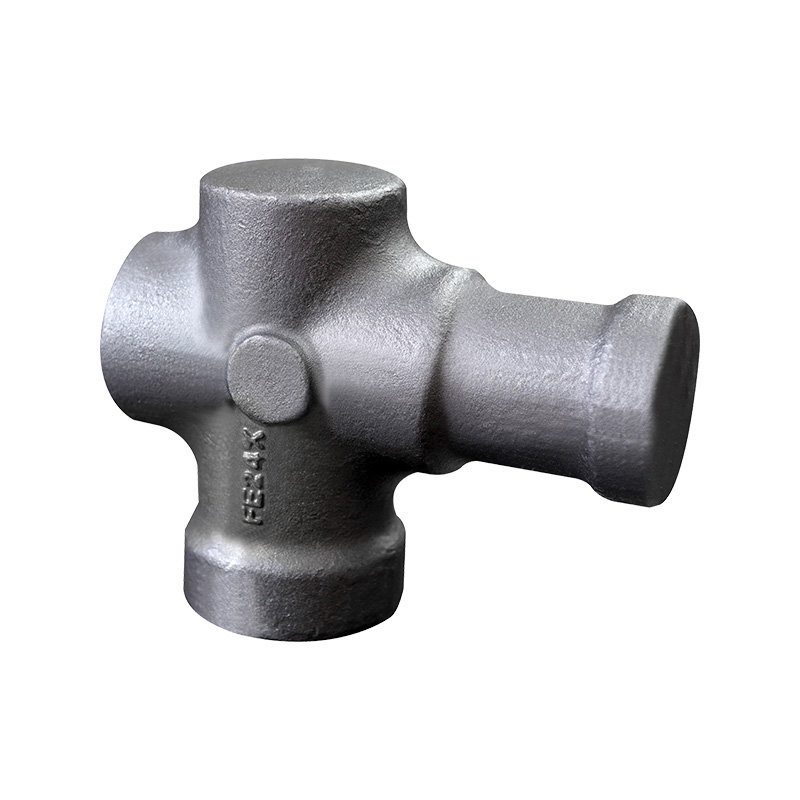
A typical gate or ball valve body sees pressure and mechanical loads but not necessarily high fluid aggressiveness, so forged low alloy steel is common for bodies and bonnets. The trim, by contrast, may be martensitic stainless like 410 or 420 for hardness, or austenitic stainless like 316 for media compatibility. For sour or chemical services, the trim is often an all-stainless design from the start.
Forged Valve Parts for Corrosive and Sour ServiceValve components must withstand varying media aggressiveness. This supplier offers forged options in both low alloy and stainless grades to match the fluid and pressure demands.View Product →
Oil and gas petrochemical parts
Flanges, hubs, and connector forgings in oil and gas sites live with a mix of hydrocarbons, brine, carbon dioxide, and hydrogen sulfide. When the corrosive fraction is low, low alloy steel with a good coating is economical. When the well stream or process feed is sour and wet, stainless steel forgings, often duplex grades, are a standard response. The higher initial cost is justified by a dramatically lower failure risk in an environment that is expensive to access for repairs.
Oil and Gas Petrochemical Forgings for Harsh ConditionsDesigned for high-pressure, corrosive environments, these forgings provide reliable pressure boundary integrity and can be tailored to specific chemical and temperature challenges.View Product →
Mining and nuclear examples
Mining machinery forgings are almost always low alloy steel because abrasive wear and impact are the governing threats. In nuclear power construction, both families show up: a forged low alloy steel such as the nickel-chromium-molybdenum grade commonly referenced as SA-508 is used for thick-walled pressure vessel components, while austenitic stainless is chosen for piping, internals, and other applications where coolant chemistry and corrosion resistance rule.
Why the Forging Method Matters for Both Steels
Whichever steel family you choose, the component's performance depends heavily on how it is produced. Forging refines the cast grain structure and aligns grain flow along the component contour, which improves fatigue strength, impact toughness, and resistance to crack propagation compared with a casting or a part machined directly from bar stock. The forging reduction ratio also consolidates internal porosity, and the preceding upsetting of the billet creates a more uniform deformation field.
For both low alloy and stainless steels, a forged plus heat-treated component will outlast an as-cast equivalent in demanding service. This is particularly visible in valve bodies, rotating shafts, and flanged fittings where a single crack can lead to a costly shutdown.
A well-equipped forger supports both material families because the difference shows up in controlled temperatures, proper heat treatment, and traceability of each heat. Our in-house forging and machining capabilities cover open-die forging, closed-die forging, and seamless ring rolling, with heat treatment and machining under one roof, and the equipment can produce parts up to 20 feet outside diameter and 40,000 pounds in single-piece weight. That range matters when a project moves from prototype to a heavy production component.
Frequently Asked Questions
1. Which is stronger: low alloy steel or stainless steel?
In the annealed condition, most austenitic stainless steels are weaker than quenched-and-tempered low alloy steels. A 4140 or 4340 forging can reach tensile strengths of 900 to 1400 MPa, while annealed 304 sits around 515 MPa. Duplex stainless is the exception among stainless families, with yield strength around twice that of 304, but it still trails the highest-strength low alloy grades.
2. Is stainless steel considered an alloy steel?
Technically yes. Stainless steel contains chromium and other alloying elements, so it meets the metallurgical definition of alloy steel. In day-to-day industrial language, however, "alloy steel" refers to low and medium alloy structural steels, while stainless steel is treated as a separate family because its chromium-based corrosion mechanism is fundamentally different.
3. Can low alloy steel be used in outdoor or marine environments?
Yes, provided it is protected. A painted, lined, or galvanized low alloy steel part can survive many years in atmospheric or even marine splash-zone service. The risk is damage to the protective layer: once moisture and chlorides reach the bare steel, corrosion can advance rapidly. If the part must run uncoated for decades, stainless steel is the safer starting point.
4. Why is 316 stainless steel more corrosion resistant than 304?
The difference is molybdenum. Adding 2 to 3% molybdenum to 316 raises its PREN from about 19 to about 26, which significantly improves resistance to chloride pitting and crevice corrosion. That is why 316 is the standard grade for seawater, brine, and many chemical services, while 304 is limited to milder dehumidified environments.
5. Does stainless steel need to be painted?
Generally no. Stainless steel forms its own passive oxide film and does not require protective coatings. Painting is sometimes applied for aesthetics or to prevent external contamination, but it is not needed for corrosion protection. Low alloy steel, by contrast, usually requires a coating in wet or humid service.
6. Can both steels be forged into the same shapes?
Yes. Both low alloy and stainless steels can be produced as open-die forgings, closed-die forgings, and seamless rings. Stainless requires tighter control of forging temperature because its working range is narrower and it has lower thermal conductivity. The geometry limits are set by the forging press and the die design, not by the steel family.
7. When should I choose low alloy steel over stainless steel?
Choose low alloy steel when the application is dry or coated, when the load demands high strength and toughness, when surface hardening is needed, and when material and machining budget matters. Mining equipment, gearboxes, shafts, flanges, and valve bodies are the classic examples. Choose stainless when wet corrosion, product purity, or high-temperature oxidation would dominate.
8. What is the cheapest way to get corrosion resistance from a forged part?
If the environment is only mildly corrosive, start with a low alloy steel forging and add a protective coating such as epoxy, zinc-rich paint, or thermal spray metalizing. If the part will sit in continuous chloride-bearing service, stainless is usually more economic over the full service life because re-coating costs repeat every few years and unscheduled downtime carries its own price.
Final Recommendation
The entire comparison can be compressed into three rules:
- If the part must survive chloride-laden moisture, chemical media, or sustained temperatures above 450 C, use stainless steel.
- If the part must carry heavy loads, take impact, resist abrasive wear, or meet a demanding cost target, use low alloy steel.
- If both corrosion and mechanical load are severe, evaluate duplex stainless or a low alloy steel with a protective system, and compare the lifecycle cost rather than only the purchase price.
For a forged component, the material choice is only the first decision. The forging design, reduction ratio, heat treatment cycle, and machining quality determine whether the grade choice actually delivers. If you are not sure which steel family suits your valve, mining, oil and gas, or industrial part, send your drawings to our engineers and let the service conditions decide. You can reach us through our contact page with the expected operating pressure, media, and temperature range, and we will help you match the forging route and steel grade to the real workload.