

 英语
英语 德语
德语 阿拉伯语
阿拉伯语

Content
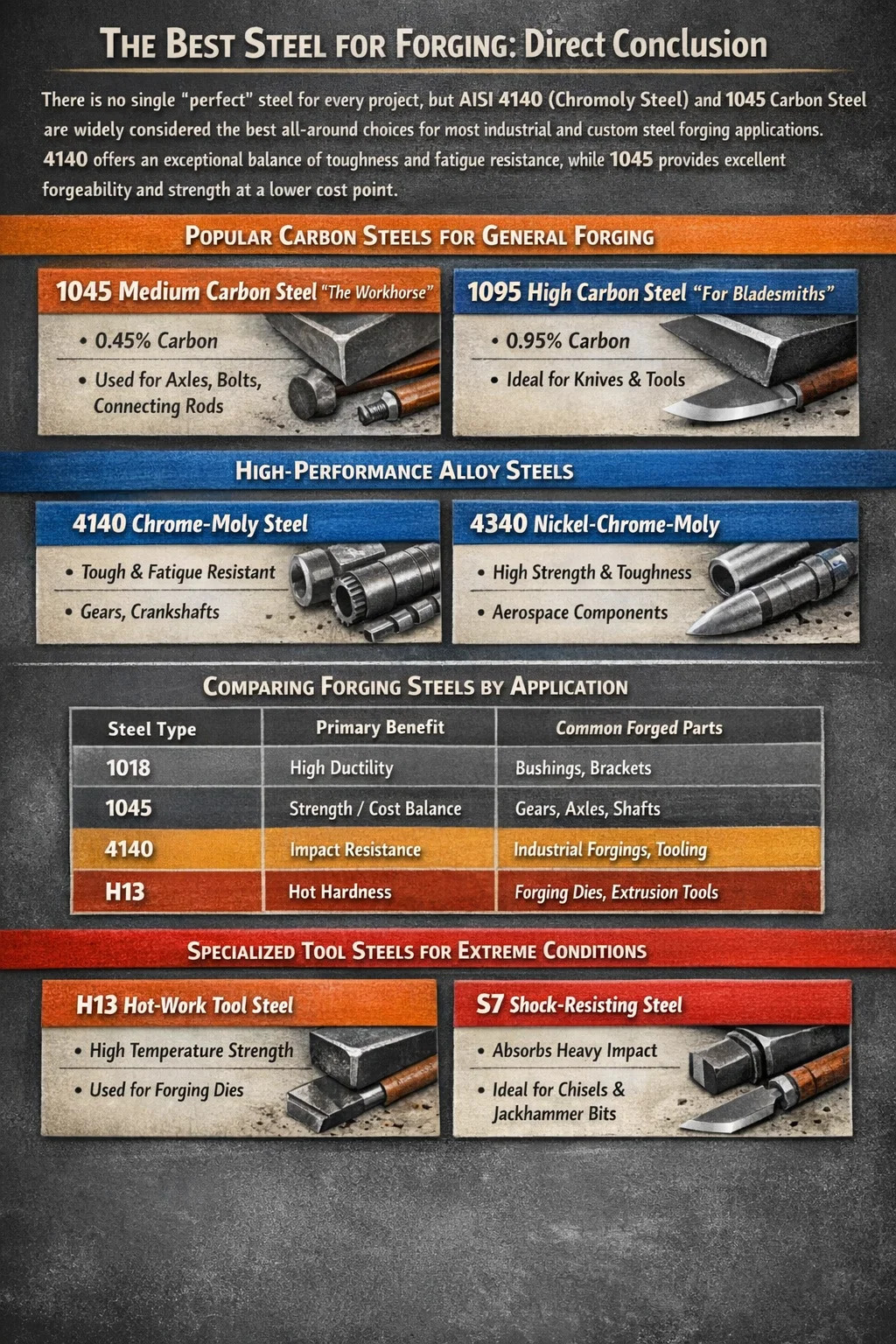
The Best Steel for Forging: Direct Conclusion
There is no single "perfect" steel for every project, but AISI 4140 (Chromoly Steel) and 1045 Carbon Steel are widely considered the best all-around choices for most industrial and custom steel forging applications. 4140 offers an exceptional balance of toughness and fatigue resistance, while 1045 provides excellent forgeability and strength at a lower cost point.
Popular Carbon Steels for General Forging
Carbon steels are the backbone of the forging industry due to their predictable behavior under the hammer and excellent response to heat treatment.
1045 Medium Carbon Steel
This is the "workhorse" of steel forging. It contains approximately 0.45% carbon, making it strong enough for structural parts but ductile enough to forge without cracking. It is commonly used for axles, bolts, and connecting rods.
1095 High Carbon Steel
Favored by bladesmiths, 1095 contains about 0.95% carbon. It achieves extreme hardness and holds a sharp edge, though it requires precise temperature control during the forging process to avoid brittleness.
High-Performance Alloy Steels for Heavy-Duty Applications
When standard carbon steel isn't enough, Alloy Steel forgings provide enhanced mechanical properties through the addition of elements like chromium, manganese, and molybdenum.
- 4140 (Chrome-Moly): Known for its high "hardenability," this steel is the gold standard for gears, crankshafts, and high-stress industrial components.
- 4340 (Nickel-Chrome-Moly): Often used in the aerospace industry, this alloy provides even higher toughness and strength than 4140, particularly in very large sections.
- 5160 (Spring Steel): Containing chromium for increased toughness, this is the preferred choice for forging suspension leaf springs and heavy-duty swords.
Comparing Forging Steels by Application
The following table outlines the best steel choices based on the intended use of the forged part.
| Steel Type | Primary Benefit | Common Forged Parts |
|---|---|---|
| 1018 | High Ductility | Bushings, Brackets |
| 1045 | Balance of Strength/Cost | Gears, Axles, Shafts |
| 4140 | Impact Resistance | Industrial Forgings, Tooling |
| H13 | Hot Hardness | Forging Dies, Extrusion Tools |
Specialized Tool Steels for Extreme Conditions
Tool steels are premium grades used when the steel forging must withstand extreme heat or constant abrasion without losing its shape.
H13 Chromium Hot-Work Steel
H13 is specifically designed to remain strong at high temperatures. It is the primary choice for making forging dies because it can withstand the thermal shock of repeated contact with red-hot billets.
S7 Shock-Resisting Steel
When a part needs to endure heavy hammering—such as chisels or jackhammer bits—S7 is the best steel. It is engineered to absorb energy without chipping or fracturing.